
Imagine a world where every click, every swipe, every wearable step, and every smart-device interaction paints a picture not just of what you do, but also why you do it, what you like, and how you make decisions. That’s the promise of Internet of Behavior (IoB). IoB goes beyond simply connecting devices; it links human behavior to data-driven insights. For businesses, from travel agencies to e-commerce shops, IoB can unlock unprecedented personalization, smarter decision-making, and deeper engagement. In this article, we’ll unpack what IoB is, explore how IoB and IoT converge, examine IoB technology trends, and discuss both benefits and risks for businesses.
Given the rising demand for data-driven marketing and UX strategies, understanding IoB has never been more essential, especially for companies like ours at Implevista, which helps clients leverage digital transformation to its fullest potential.
What is Internet of Behavior (IoB)
The Internet of Behavior (IoB) is an emerging concept that focuses on collecting, analyzing, and interpreting data about how people behave across digital platforms. It goes beyond traditional IoT by studying why users act a certain way and how their behavior can be predicted or influenced. IoB uses data from devices, apps, sensors, and online interactions to help businesses create more personalized experiences, improve decision-making, and understand customer needs more deeply.
Key Highlights:
- Behavior-focused approach: IoB analyzes actions, patterns, and motivations behind user behavior.
- Multiple data sources: Uses information from smartphones, wearables, smart home devices, social media, and browsing habits.
- Combines tech + psychology: Integrates IoT data with behavioral science, AI, and analytics.
- Business impact: Helps companies personalize services, optimize marketing, and predict customer needs.
- Growing relevance: As digital interactions increase, IoB is becoming essential for data-driven strategies and customer experience mapping.
In short, IoB transforms raw digital traces into meaningful behavioral models, offering companies a new layer of insight-driven personalization.
IoB and IoT Convergence and Differences
It’s common to conflate the Internet of Behavior (IoB) with IoT, but they serve distinct roles in the data ecosystem. Let’s break this down.
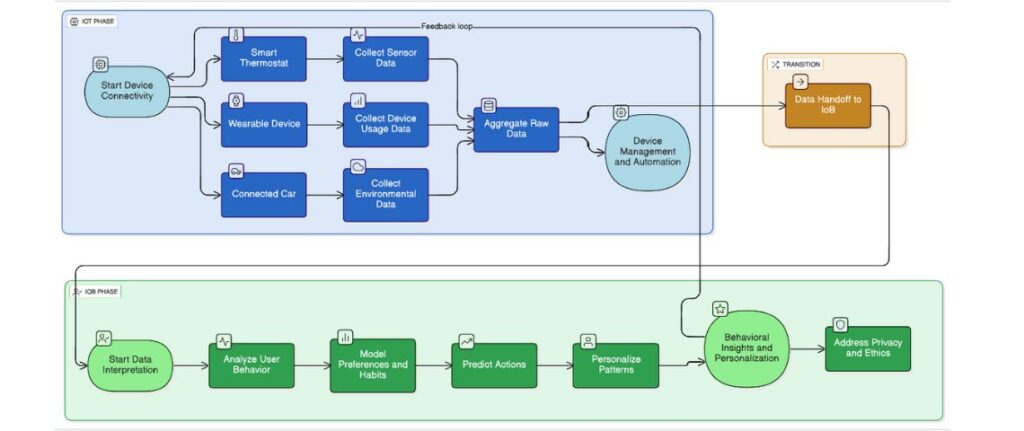
Where IoT Ends, IoB Begins
| IoT | IoB |
| Focuses on connecting devices and collecting sensor/data streams (e.g., smart thermostat, wearable, connected car) | Focuses on interpreting user behavior data derived from those devices, what users do, how they act, when and why |
| Provides raw data (e.g. movement, temperature, device usage, sensor logs) | Provides behavioral insights (preferences, habits, predicted actions, personalized patterns) |
| Concern: data collection and connectivity | Concern: data interpretation, behavioral modeling, privacy & ethics |
IoB doesn’t replace IoT; rather, it builds upon it. IoT provides the data, IoB gives it meaning.
Why Internet of Behavior (IoB) and IoT Convergence Matters
- As more homes, cities, and workplaces adopt IoT devices (smart home sensors, wearables, industrial sensors), the volume of “digital dust” grows.
- IoB transforms that dust into actionable knowledge, enabling personalization at scale, predictive analytics, and behavior-driven services.
- For businesses and governments, IoB enables strategic planning, from marketing campaigns to public policy interventions, based on real behavioral patterns rather than guesswork.
Internet of Behavior (IoB) Technology Trends: What’s Shaping the Future
Here are some of the most notable trends shaping IoB’s evolution today and the years ahead.
1. Rise of Wearables, Sensors & Ubiquitous Data Collection
- As smartwatches, fitness trackers, smart home devices, and connected appliances become more pervasive, the data points available for behavioral analysis increase dramatically.
- Greater penetration of mobiles and IoT-enabled devices globally, meaning more behavioral digital dust from everyday activities (mobile usage, location tracking, app interactions, wearable sensors) to feed IoB systems.
- Integration of multiple data sources: IoT, wearables, transaction histories, social media, and device usage logs, aggregating into a unified behavioral data lake.
2. Advances in AI, Machine Learning & Behavior Computing
- Modern IoB systems leverage machine learning and behavioral computing to process massive datasets, detect patterns, infer intentions, and even predict behavior.
- Research into IoB architectures outlines multi-layer models: from behavior perception → behavior networking → behavior computing → service provision → security/privacy.
- Use of real-time analytics and automated feedback loops: as IoB gathers data, systems can adjust offers, triggers, or services in real time, influencing behavior dynamically rather than post-factum.
3. Industry-Specific Applications: From Retail to Smart Cities
IoB is not one-size-fits-all; its strength lies in adaptability across sectors:
- Retail & E-commerce: Personalized recommendations, dynamic pricing, targeted marketing based on browsing, purchase history, and behavioral patterns.
- Healthcare & Wellness: Wearables tracking health data like vitals, activity, and sleep are used to promote preventive care, adherence to medical regimes, and healthier lifestyles.
- Insurance & Finance: Usage-based insurance (UBI) using driver behavior data (telematics), financial institutions evaluating creditworthiness via behavioral patterns, or fraud detection by analyzing transaction behaviors.
- Smart Cities & Urban Planning: Leveraging aggregated citizen data (mobility, resource usage, public transport interactions) to optimize infrastructure, manage traffic, energy consumption, and civic services.
- Workplace & Organizational Efficiency: Monitoring employee workflows, attendance, movement, health compliance, and optimizing operations based on behavioral insights.
4. Growing Focus on Privacy, Ethics and Security, and Decentralized Internet of Behavior (IoB)
- As IoB systems collect rich, often sensitive behavioral data, privacy and ethical use become top concerns.
- Recent research (2025) explores decentralized, user-centric data management frameworks for IoB, e.g., using blockchain and zero-knowledge proofs to separate behaviour from identity, allowing data analysis without compromising privacy.
- Regulatory pressure and public awareness will likely force organizations to adopt transparent opt-in policies, robust encryption, and secure architecture, making “privacy-first IoB” a bigger trend.

Why Internet of Behavior (IoB) Matters for Businesses (Especially in Bangladesh & Emerging Markets)
If you run a business, especially in a market like Bangladesh where digital adoption is accelerating, here’s why IoB deserves your attention:
- Hyper-Personalization at Scale
- IoB enables delivering personalized experiences, tailored offers, recommendations, and services based on real user behavior rather than demographic assumptions.
- That translates to better customer satisfaction, higher engagement, and improved conversion rates.
- Data-Driven Decision Making
- Instead of gut-feel or generic analytics, business decisions (marketing, product development, customer segmentation) can be grounded in behavioral evidence.
- For enterprises offering digital solutions (like our own), this means building smarter products, whether SaaS, e-commerce platform or mobile app.
- Competitive Advantage for SMEs
- As noted by analysts, SMEs captured a large share of early IoB market adoption, providing cost-effective data-driven tools for companies without massive budgets.
- For growing SMEs in Bangladesh or South Asia, leveraging IoB can level the playing field with global competitors by offering highly bespoke customer experiences.
- Synergy with Digital Services and Marketing
- Agencies like Implevista Digital, with expertise in content marketing, SEO, data analytics, and IoT solutions, are ideally positioned to help clients adopt IoB-driven strategies. Indeed, Implevista already offers IoT solutions under its services portfolio.
- Combining IoB insights with content marketing or digital campaigns enables hyper-targeted content, better user journeys, and stronger ROI.
- Readiness for Future Tech & Compliance
- As privacy regulations tighten globally, investing early in privacy-aware IoB frameworks (e.g. decentralized data storage) can make businesses compliant and future-proof.
- Data security and ethical data handling will not just be optional, but mandatory for trust and long-term brand reputation.
Challenges and Risks: The Other Side of Internet of Behavior (IoB)
While IoB brings a lot of promise, there are significant caveats businesses must be aware of.
- Privacy & Ethical Concerns: Tracking behaviour, online and offline, can feel invasive. Without clear consent and transparency, users may perceive IoB as surveillance rather than a service.
- Security Risks: Massive behavioral datasets increase the attack surface for breaches. Sensitive data (location, health, finances) must be protected diligently.
- Regulatory Uncertainty: Different jurisdictions have varying privacy/data-protection laws. What might be fine in one country could be illegal in another.
- Bias & Manipulation: Behavioral data might be misinterpreted, leading to unfair profiling, discrimination, or manipulation (e.g., pricing, offers, insurance premiums).
- Infrastructure & Cost: Aggregating, storing, and processing large-scale behavioral data requires robust infrastructure, which may be challenging for small businesses or in emerging markets with limited tech maturity.
IoB Technology Trends: What Businesses Should Watch (2026 and Beyond)
Given current research and market direction, businesses should particularly monitor these emerging trends in IoB:
- Decentralized, Privacy-First IoB Architectures: New models that separate identity from behavior, use encryption, zero-knowledge, or blockchain to protect personal data while retaining analytic power.
- Real-time Behavioral Feedback & Adaptive Services: Systems that respond instantly to behavior signals: e.g. smart apps adjusting user experience based on mood, location, activity, or context; adaptive UIs or recommendations.
- Cross-Platform Behavioral Profiling & Unified Data Lakes: Integrating data from wearables, mobile apps, web behavior, IoT devices, transactions, and more, enabling a 360° user view and deeper personalization.
- Ethical AI & Responsible Behavior Analytics: As critique grows, businesses adopting IoB will need transparent consent mechanisms, clear data policies, and fairness-aware analytics to maintain trust.
- Domain-Specific IoB Solutions: Vertical-specific IoB platforms, e.g., health-IoB, smart-city IoB, retail-IB, or education-IoB, tailored to the unique data and regulatory needs of each industry.

How a Company Like Implevista Can Help You Harness IoB
Given our services and expertise, here’s how Implevista is well-positioned to help you leverage IoB for business growth:
- IoT Solutions & Implementation: As part of our core offerings, Implevista provides IoT solutions, which can serve as the data foundation for any IoB initiative.
- Data Analytics & Business Intelligence: Through our analytics and BI services, we can process behavioral data, build behavioral models, and help extract actionable insights for personalization, user experience, or marketing.
- Digital Marketing & Content Strategy: With our content marketing, SEO, and digital services via Implevista Digital, we can combine IoB insights with marketing, delivering hyper-targeted campaigns and personalized content based on user behavior.
- Custom Software & SaaS Development: For organizations seeking tailored behavior-driven apps (mobile or web), Implevista can develop custom software that integrates IoB logic, for example, adaptive services or recommendation engines based on user behavior.
If you’re considering exploring IoB for your business, whether as a startup, SME, or enterprise, Implevista can be your technology and consultancy partner.
FAQ: Internet of Behavior (IoB)
- What is the Internet of Behavior (IoB) in simple terms?
IoB (Internet of Behavior) refers to collecting data about human behavior via devices, sensors, apps, and analyzing it to understand, predict, and influence how people behave, both online and offline. - How does the Internet of Behavior (IoB) differ from IoT?
IoT (Internet of Things) connects devices and sensors to collect raw data. IoB builds on that data, applying analytics and behavioral science to translate device data into human behavioral insights. - What kinds of data does the Internet of Behavior (IoB) use?
It can use sensor data, wearable/biometric data, location and movement data, user interactions (app usage, browsing), transaction history, social media engagement, and more, practically any digital “footprint.” - Which industries benefit most from the Internet of Behavior (IoB)?
Many: retail & e-commerce, healthcare, insurance and finance, smart cities & urban planning, education, workforce productivity, travel & hospitality, and more. - What are the risks or downsides of IoB?
Potential privacy violations, security vulnerabilities, ethical concerns (profiling or manipulation), regulatory compliance challenges, and dependency on robust tech infrastructure. - Is IoB already being widely used?
Yes, increasingly. Many companies and sectors, from health-tech to retail, have started experimenting with IoB. Market analysts estimate significant growth ahead. - How can small businesses or SMEs adopt IoB?
SMEs can start by collecting behavioral data (e.g. via apps, CRM, IoT sensors), then use analytics tools to draw insights. They can also collaborate with agencies (like Implevista) to implement IoB-driven marketing or software solutions. - What technologies power the Internet of Behavior (IoB)?
IoT devices and sensors, big data platforms, machine learning / AI, predictive analytics, data lakes/data warehouses, cloud infrastructure, sometimes combined with privacy-aware architectures (e.g. decentralized storage). - What does the future of the Internet of Behavior (IoB) look like?
The future is likely to bring more privacy-preserving IoB, real-time adaptive systems, vertical-specific IoB solutions (health, smart city, retail), and deeper integration with AI-driven services for personalization and predictive behavior modeling. - How can I get started with IoB for my business?
Begin with data collection, identify what behavioral data you already have (e.g., website usage, CRM, mobile app, sensors). Then analyse data for patterns and insights. If needed, partner with a technology agency (e.g,. Implevista) to build custom tools, analytics pipelines, or integrate IoB into your marketing or service delivery.
The Internet of Behavior (IoB) represents a new frontier, where data and human behavior converge, creating opportunities for personalization, smarter services, and data-driven decision-making. For businesses in Bangladesh and beyond, embracing IoB can be a game-changer, especially when aligned with strong ethical practices and robust privacy safeguards.
If you’re curious about how to start leveraging the Internet of Behavior (IoB) for your business, whether through IoT, behavioral analytics, or tailored software, we at Implevista are ready to help. Contact us today to explore how IoB can transform your customer experience. You can also subscribe to our blog for more insights into future tech trends, or check out our services in IoT, custom software development, and digital marketing to get started.