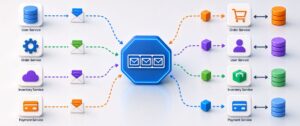

In the modern digital economy, SaaS products are no longer a luxury; they’re a strategic necessity for almost every business vertical, from startups to enterprises. SaaS, or Software as a Service, refers to cloud-based software accessible over the internet rather than installed locally on desktops or servers. This model offers unmatched advantages like subscription-based pricing, continuous delivery of updates, and seamless accessibility from any device—benefits that traditional software simply cannot match.
However, what truly separates SaaS products that scale rapidly from those that stagnate is the architecture that underpins them. A well-designed SaaS architecture allows applications to support thousands, even millions, of users without degrading performance. It also ensures reliability, security, and maintainability over time. This article explores the key architectural principles, patterns, and strategies relevant to building high-growth SaaS products optimized for scalability, resilience, and innovation.
Quick Takeaways
- Why SaaS architecture drives growth.
- Key layers that make SaaS scalable.
- How multi-tenant and cloud-based designs work.
- Modern patterns like microservices and observability.
- Future trends shaping high-growth SaaS products.
Understanding SaaS Products Architecture and Its Role in Growth
At its core, SaaS architecture defines how software components, user interfaces, data layers, and integrations are organized and interact within a cloud environment. Unlike traditional on-premise software, SaaS applications are inherently connected to shared infrastructure, which enables automatic upgrades, multi-tenant access, and centralized maintenance.
This architecture is more than just technology design; it shapes how efficiently a SaaS product can adapt to demand spikes, integrate with third-party systems, and provide a secure user experience. A thoughtfully constructed SaaS architecture is therefore a foundation for rapid user acquisition, high customer retention, and long-term growth.
Core Layers of SaaS Architecture: A Closer Look
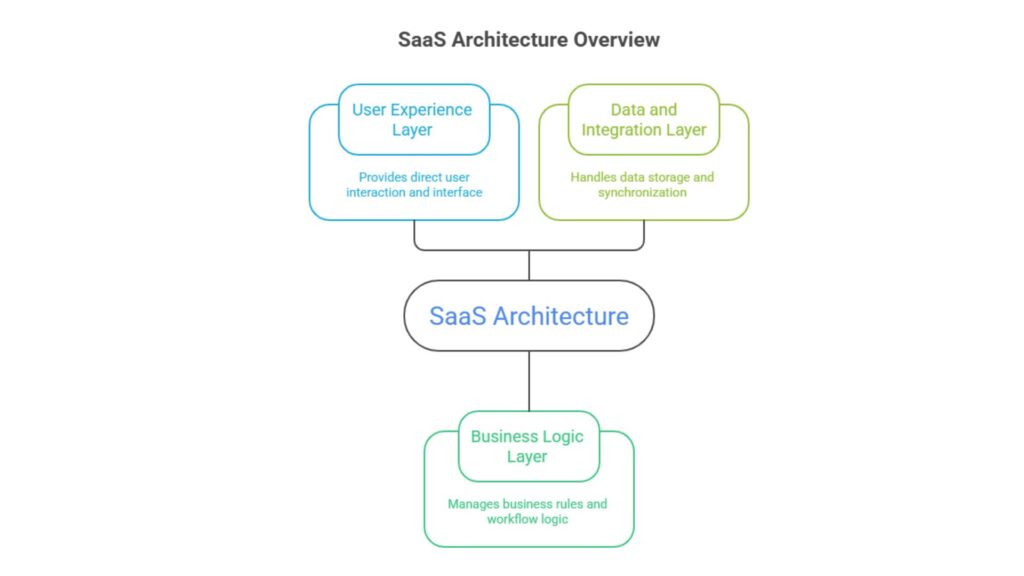
A high-growth SaaS product typically consists of multiple architectural layers, each fulfilling specific responsibilities while working cohesively:
- User Experience and Presentation Layer
This layer is what users interact with directly. It includes the web dashboard, mobile app interfaces, and embedded client experiences. A smooth, intuitive UI not only enhances customer satisfaction but also reduces friction during onboarding and everyday use, a key driver for retention.
- Business Logic Layer
Often called the application layer, this part interprets user actions, enforces business rules, and manages workflow logic. It’s usually built using scalable frameworks and services that support modular expansion as requirements grow.
- Data and Integration Layer
This layer manages how data is stored, retrieved, and synchronized across systems. For SaaS products, this often includes cloud databases, caching strategies, and secure integration pipelines with external services like analytics platforms or payment processors.
These architectural layers work together to create a cohesive platform that is resilient, maintainable, and ready to support rapid user growth.
Multi-Tenant SaaS Architecture: Fueling Scalable Success
A defining characteristic of many modern SaaS platforms is their multi-tenant architecture, a design where a single application instance serves multiple customers, while keeping each customer’s data logically isolated.
Why Multi-Tenancy Matters for High-Growth SaaS
Multi-tenant SaaS architecture enables:
- Shared resource efficiency, because multiple customers use the same codebase and infrastructure.
- Centralized updates and maintenance reduce the operational burden on your engineering team.
- Faster onboarding, as provisioning new tenants does not require deploying separate instances.
This model accelerates growth by lowering costs, improving maintainability, and simplifying performance scaling.
Typical Multi-Tenant SaaS Architecture Strategies
There are different ways to structure multi-tenant data:
- Shared database with shared schema, which is simple and cost-effective.
- Shared database with tenant-specific schemas, which increases logical separation.
- Separate databases per tenant, which is more isolated and secure, but can be costly and complex.
Choosing the right approach depends on your performance needs, compliance requirements, and projected user growth.
Understanding SaaS Tenancy Models
When designing a SaaS product, a key architectural choice is how customer environments are separated. In a multi-tenant SaaS architecture, multiple customers share the same application instance and infrastructure, with each customer’s data kept logically separate. This approach makes the system more cost-efficient and easier to scale. In single-tenant architecture, each customer gets a dedicated instance of the software and resources, offering stronger isolation and customization at the cost of higher infrastructure needs and maintenance effort. These differences impact scalability, security, cost, and product strategy
| Feature | Multi-Tenant Architecture | Single-Tenant Architecture |
| Resource Utilization | Multiple customers share the same application and database infrastructure. This leads to lower costs per tenant due to shared resources. | Each customer has a dedicated instance of the application and database, leading to higher infrastructure costs. |
| Scalability | Easy to add new customers without deploying new instances, making it highly scalable and efficient. | Requires provisioning of new instances for each customer, which can be slower and more resource-intensive. |
| Customization | Limited per-tenant customization because all customers run on a shared codebase. | Offers deep customization per tenant, as each customer’s environment is separate. |
| Security & Isolation | Logical isolation is used to protect data, and proper access controls are essential. | Strong isolation by default since each tenant’s environment is separate, which can simplify compliance needs. |
| Maintenance & Updates | Centralized updates and patches are deployed once for all tenants | Updates may need to be applied individually to each tenant’s environment. |
Cloud-Based SaaS Architecture
The cloud is the backbone of scalable SaaS architecture. Leveraging cloud-native infrastructure allows teams to build software that is dynamically scalable and resilient by design.
Cloud-based SaaS architecture benefits from features like:
- Auto-scaling compute resources
- Serverless execution models
- Managed database solutions
- Global distribution networks
These capabilities enable SaaS products to respond to changing demands without manual intervention, ensuring uptime and performance even under unexpected loads.
Adopting cloud best practices also supports modern deployment processes, such as continuous integration and continuous deployment (CI/CD), which help teams roll out updates reliably and quickly.
Microservices and Modular Architecture: Breaking Down Complexity
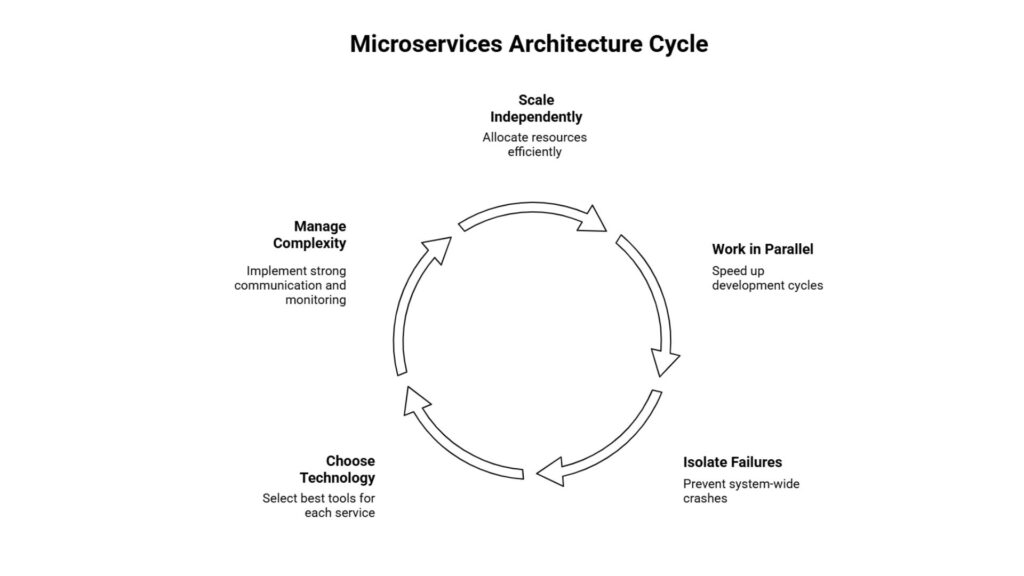
As SaaS products grow beyond basic features, teams often adopt a microservices architecture, splitting a system into smaller, independently deployable services that each handle a specific function (like user authentication, billing, or notifications). This modular design helps SaaS teams move faster and scale more effectively because:
- Each service scales independently, letting you allocate resources only where needed and avoid scaling the whole platform at once. This improves performance and cost efficiency.
- Teams can work in parallel, speeding up development and deployment cycles without waiting on changes in other parts of the system.
- Failures remain isolated, so problems in one service won’t crash the entire application, boosting reliability.
- Technology flexibility lets teams choose the best tools for each service instead of being tied to a single stack.
However, the microservices approach also adds architectural complexity. Managing many services requires strong communication patterns (usually through APIs), sophisticated deployment tooling, and thorough monitoring so you can detect issues quickly and avoid unexpected bottlenecks.
Overall, microservices are a powerful pattern for high‑growth SaaS platforms, but they require thoughtful planning and engineering practices to ensure modularity doesn’t become overhead.
Performance, Monitoring, and Observability: Staying Ahead of Issues
High-growth SaaS products gather real-time data around performance, usage patterns, and errors. This observability helps teams identify performance bottlenecks before they impact users.
Key concerns include:
- Latency tracking for user requests.
- Uptime metrics to ensure service availability.
- Anomaly detection, which identifies unusual behavior across the platform.
Modern monitoring tools like Datadog, New Relic, or cloud provider suites enable developers to visualize performance trends and correlate incidents with root causes.
Security and Compliance: Building Trust in SaaS
Security is foundational, not optional. An excellent SaaS product secures data at all layers, in transit, at rest, and during processing.
Best practices include:
- Enforcing role-based access controls.
- Encrypting sensitive data.
- Applying strong authentication mechanisms like multi-factor authentication.
Meeting international compliance standards also strengthens customer trust, especially when serving regulated industries.
How Implevista Engineers Scalable SaaS Products
Building high-growth SaaS requires more than features—it demands a robust, scalable, and secure architecture. Implevista approaches SaaS development with an architecture-first mindset, focusing on multi-tenant, cloud-native, and modular systems.
Key aspects of their approach include:
-
Multi-tenant architecture with secure data isolation
-
Modular, service-oriented design for flexibility and scalability
-
Cloud-native infrastructure supporting high availability and horizontal scaling
-
Optimized technology stacks for performance and maintainability
-
Secure APIs and integration layers for third-party systems
Implevista supports both new SaaS products and modernization of existing platforms, improving performance, reducing technical debt, and ensuring long-term scalability.
Post-deployment services include:
-
Monitoring and performance tuning
-
Infrastructure optimization
-
Security hardening and compliance
-
Continuous iterative improvements
For a full technical walkthrough—from requirements and MVP architecture to deployment and ongoing optimization—their SaaS development guide details the complete engineering lifecycle.
Evolving Trends in SaaS Architecture
The SaaS landscape continues to evolve rapidly. Some emerging trends shaping the future include:
- Distributed and Edge Architectures
Extending processing closer to the user to reduce latency and optimize global performance. - AI-Driven Scaling
Using machine learning to optimize auto-scaling and resource utilization across peak and off-peak periods. - API-First Strategies
Prioritizing APIs so SaaS products can interoperate seamlessly with third-party systems and integrations.
These trends point to a future where SaaS products are not just scalable, but intelligent and highly interconnected.
Frequently Asked Questions About SaaS Products Architecture
What does SaaS architecture mean?
SaaS architecture refers to how a software product is organized, deployed, and managed in a cloud-based model, with scalability, multitenancy, and continuous delivery in mind.
Why is cloud-based SaaS architecture important?
Cloud architecture enables dynamic scaling, high availability, and flexibility that traditional on-premise software architectures can’t match.
How does multi-tenant architecture help SaaS growth?
Multi-tenant models let multiple customers share the same application instance, reducing costs and centralizing updates.
Can security be strong in a multi-tenant SaaS product?
Yes, with proper data isolation, encryption, and authentication strategies, multi-tenant systems can be as secure as single-tenant deployments.
Are microservices always better for SaaS products?
Microservices offer benefits for modularity and scalability, but they also add complexity. The choice depends on product size and future growth plans.
What monitoring tools should SaaS teams use?
Tools like Datadog, New Relic, or cloud-provider built-in suites help track performance and uptime.
Why is observability essential for SaaS?
Observability helps teams detect and resolve issues quickly, improving reliability and user trust.
What architecture patterns are trending in SaaS?
Cloud-native, API-first, and serverless models are increasingly popular for modern SaaS.
How does Implevista support SaaS development?
Implevista provides SaaS architecture consulting, custom development, integration, and post-launch support services.
Where can I learn more about SaaS development with Implevista?
Visit our blog for insights on SaaS design, development best practices, and architectural guidance.
A robust, scalable SaaS architecture is a major competitive advantage. It ensures your product can handle growing demand, remain secure, and deliver continuous value to users. By applying multi-tenant design, cloud-native principles, and modular architectures, you position your SaaS product for long-term growth.
Ready to turn your SaaS vision into reality with expert architectural guidance and development support? Contact Implevista to discuss your project and see how our SaaS expertise can power your product. Explore our services and subscribe to the Implevista blog for more insights.