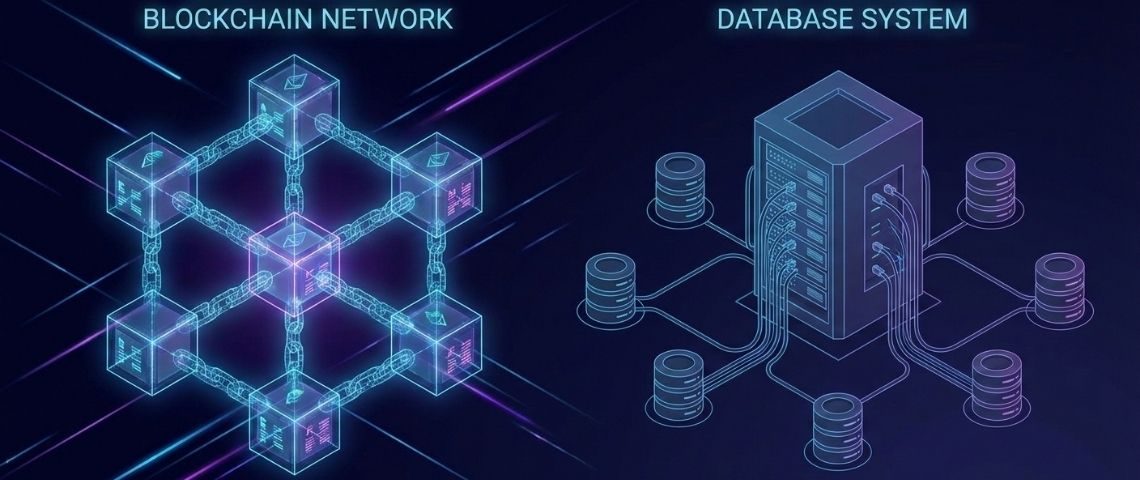
The debate between blockchain vs traditional databases centers on how each system stores, manages, and secures data. Traditional databases (like relational or NoSQL systems) are centralized ledgers run by a single authority or organization, often with full read/write control. In contrast, blockchain is a decentralized, distributed ledger that uses cryptographic links between blocks of data.
Unlike a conventional database, a blockchain’s data structure and trust model are fundamentally different. For example, Investopedia notes that “the key difference between a traditional database or spreadsheet and a blockchain is how the data is structured and accessed”. In this article, we’ll explore these differences in depth, covering architecture, decentralization, performance, and more, so you can decide which approach fits your needs.
Blockchain technology was popularized by cryptocurrencies but now extends to many industries. It eliminates the need for a single, trusted database administrator by distributing copies of the ledger to all participants (nodes). Each new block of data must be validated by consensus and cryptographically chained to the previous block, making it immutable once added.
In contrast, traditional databases use tables, rows and columns (like a spreadsheet) controlled by one entity, with full ability to insert, update, or delete records as needed. The differences have big implications for data security, transparency, trust, and performance, which we’ll unpack in the sections below.
Blockchain vs Traditional Database Models
At the core, blockchains and databases are both data storage systems, but their architecture could not be more different. A traditional database usually follows a client–server model: a central server hosts the data, and clients (applications or users) access it.
Database administrators grant permissions, manage backups, and ensure integrity. In this setup, all data is stored in one (or a few) centralized repositories. By contrast, blockchain operates as a distributed ledger: every node in the network holds a copy of the entire chain. Data in blockchain is grouped into cryptographic “blocks” that link together in a sequence.
This means:
- Data Storage: In a blockchain, every transaction is recorded as an immutable block, encrypted and time-stamped. Once added, a block cannot be altered without rewriting all subsequent blocks. In a traditional database, records live in tables and can be edited or deleted under admin control. Investopedia explains that blockchains and databases both store information, but the “key difference is how the data is structured and accessed”. Databases use rows and columns, whereas blockchains use linked blocks via cryptographic hashes.
- Data History: Traditional databases typically keep only the latest state, or a limited history of changes. Blockchain by design preserves the full history of transactions. Every block is linked and time-stamped, creating a verifiable audit trail that can be replayed from inception. As one expert notes, “traditional databases maintain up-to-date information and can give a snapshot of a moment in time. Blockchain databases…can reproduce vast amounts of their own history”.
- Redundancy & Resilience: Because blockchain nodes replicate the data across the network, it is highly redundant and fault-tolerant. If one node fails, others maintain the data. Traditional centralized databases, however, have a single point of failure. If the main server goes down or is compromised, the whole database can be affected. As one analysis points out, centralized databases “rely on a single server or a cluster of servers controlled by an authority” and “are not as redundant… as peer-to-peer networks”. In short, blockchain’s architecture avoids a single point of vulnerability at the expense of more complex consensus mechanisms.

Decentralized vs Centralized Databases
A fundamental difference is control. Traditional databases are centralized: one organization (or a cluster of servers it controls) dictates the data flow. Administrators determine who can read or write data. By contrast, blockchain is inherently decentralized.
No single party has full control. Every participant (or “node”) can contribute to the ledger and help validate transactions. As Implevista explains, blockchain “does not rely on a central authority” and instead uses consensus to validate entries. This means trust is distributed: you don’t have to trust one admin or server; you trust the network’s rules (cryptography and consensus).
- Trust Model: In traditional databases, users must trust the database owner or administrators to maintain integrity. With blockchain, trust is built in. Every new block is validated collectively by the network (for example via Proof-of-Work or Proof-of-Stake) before being added. As a result, “multiple parties that do not trust each other can still share information securely” without a middleman. This trustless design is ideal for multi-party scenarios (like cross-border finance or supply chains) where no single party should have unilateral control.
- Consensus Mechanisms: Centralized databases rely on simple transaction commits by admins. Blockchain employs consensus algorithms. Each block must meet complex criteria (hash puzzles, voting, etc.) agreed upon by nodes. This adds security but also latency (as we’ll discuss later). Traditional DBs use ACID transactions to maintain consistency, whereas blockchain uses protocols to ensure distributed consensus.
- Permissions and Privacy: Not all blockchains are fully open – there are permissioned blockchains where only approved nodes can write. However, even permissioned blockchains decentralize control among several known parties. In contrast, traditional databases are usually private, with tight access controls set by the owner. GlassHouse Systems contrasts this well: “Traditional databases offer privacy, confidentiality and control. Blockchain is publicly accessible and is all about uncontrolled write accesses, as long as you have the right proof of work”. (In practice, many enterprise blockchains strike a balance with permissioned networks.)
In summary, decentralization vs centralization is a key axis of difference: blockchains spread trust and data across nodes, whereas traditional databases concentrate control. This has big implications for security (described next) and for performance.
Security & Immutability vs Modifiable Data
Security in blockchain relies on cryptography and the distributed architecture. Every block contains a cryptographic hash of the previous block, creating an unbreakable chain. If an attacker tries to alter one block, it breaks all subsequent hashes, which the network instantly detects.
This makes blockchain records effectively tamper-proof. In practice, once data is on-chain, it is immutable. Implevista’s technology blog notes that a blockchain record “cannot be changed” once added, ensuring data integrity. By contrast, traditional databases allow record edits or deletes. This flexibility makes them fast, but also means data can be maliciously altered if a bad actor compromises the admin account.
- Cryptography: Blockchains use advanced cryptographic techniques by default. Each transaction is signed with the sender’s private key, and hashing ensures a unique fingerprint. This provides built-in security. Traditional databases do use encryption and access controls, but if the central server is breached, attackers may tamper with data before encryption (or steal the data entirely). The decentralized nature of blockchain means even if one node is hacked, the others keep the ledger safe.
- Auditability & Transparency: Blockchains provide transparent audit trails. All transactions are recorded and visible to authorized participants, and permanent. This is crucial in contexts like finance or supply chain, where you need an auditable record. Traditional databases can keep logs, but those logs can be manipulated (since admins control them). Blockchain’s transparency builds trust: any attempted fraud is obvious on the ledger.
- Consensus & Validation: Before new data is committed, blockchain nodes must reach consensus. This prevents unauthorized or invalid transactions. Traditional databases lack this feature; once a privileged user submits a change, it is finalized immediately. While database admins may impose internal checks, these are not as robust as a global consensus. As a result, blockchains are highly resistant to fraudulent changes.
- Real-World Security Examples: Using a blockchain can eliminate common single-point attacks. For example, Implevista highlights that by “decentralizing storage, blockchain removes single-target databases that hackers commonly attack”. In a multi-node system, an attacker would need to compromise a majority of the network to cause harm, which is exponentially harder than attacking one server. In fact, experts note that even if one node is breached, “the correct data on other nodes preserves the network’s integrity”.
Thus, blockchain’s security comes from distributed trust, cryptography, and immutability, whereas traditional databases rely on perimeter security and administrative controls. This means blockchains prioritize data integrity and auditability over flexibility.

Performance and Scalability
Blockchain’s robust architecture comes at a cost. Because every transaction must be confirmed by the network, blockchains are generally slower and less scalable than traditional databases. In a conventional DB, once a transaction is validated by the central server, it commits instantly.
Blockchains, especially public ones, add overhead: generating proofs-of-work, reaching consensus among nodes, and propagating blocks to the network takes time. GlassHouse Systems observes that “the nature of blockchain is such that it delivers security at the cost of speed,” noting the effort required for each block creation. Traditional databases, by contrast, have been optimized for decades to handle thousands of transactions per second with minimal latency.
Key points about performance:
- Transaction Throughput: Major blockchains (e.g., Bitcoin, Ethereum) process only a handful to a few dozen transactions per second. Enterprise blockchains are faster but still limited by consensus. Traditional DBs can process millions of operations per second, scaling by adding hardware or partitioning. If your application needs very high throughput (e.g., real-time analytics, web services), traditional databases usually win on raw performance.
- Latency: Every blockchain transaction faces network latency and block confirmation time. A Bitcoin transaction takes ~10 minutes per confirmation; even fast blockchains need seconds or more. Traditional DB transactions are almost instantaneous under normal load.
- Scaling: Because blockchains replicate data to every node, adding more users increases overhead linearly. Several techniques (sharding, Layer-2 networks) are emerging to improve blockchain scaling, but these add complexity. Traditional databases scale more predictably through replication, sharding, or cloud scaling. As Implevista notes, centralized databases often face scaling limits due to their architecture, while blockchains can scale horizontally by adding nodes.
- Resource Use: Consensus methods like Proof-of-Work consume significant energy. Traditional databases mostly draw power proportional to their compute load, which is typically lower. This difference is a practical concern in large deployments.
In summary, traditional databases outpace blockchains in speed and large-scale performance. For many applications (e.g., typical business apps, websites, analytics), a centralized database is more efficient. Blockchain is chosen when its security or trust properties outweigh these performance costs.
Use Cases and Practical Examples
The choice between blockchain and a traditional database often comes down to use case. Some scenarios naturally fit one model better than the other.
- Blockchain Strengths: Blockchain shines in multi-party environments where participants do not fully trust each other or a central authority. For example, cryptocurrencies like Bitcoin require a trustless, decentralized ledger. Supply chain tracking uses blockchain to provide an immutable provenance record, as companies like Walmart do (tracking food from farm to store). Smart contracts on Ethereum automate agreements (e.g. in real estate or insurance) without intermediaries. Identity and healthcare systems may use blockchain to give individuals control over their own data. Generally, if you need transparency, tamper-proof history, and no single-point control, blockchain is compelling.
- Traditional Database Strengths: Standard enterprise needs – ERP, CRM, inventory management, user profiles, and so on – typically rely on traditional databases. These systems require flexible querying, fast transactions, and private data control. Implevista’s analysis lists classic uses: ERP systems store transactional business data, CRMs hold customer records, and data warehouses aggregate structured data for reporting. These applications work well with relational or NoSQL databases, where data can be edited, relationships can be updated, and schemas can evolve easily.
- Complementary Uses: Often blockchain complements rather than replaces. For instance, a company might use a traditional database for most internal data but anchor important summaries (like total audit logs or milestones) on a blockchain for verifiability. As one expert notes, blockchain “often complements, rather than replaces, existing database systems,” providing extra trust for critical data.
In practice, businesses match technology to needs. Blockchain’s decentralized ledger is perfect for secure digital transactions and records across untrusted networks, whereas traditional databases remain the workhorse for everyday data storage and queries. Some organizations use both: “Implevista provides expertise to build secure, modern blockchain solutions” for trust-sensitive applications, while also offering standard software services to handle conventional data needs.

When to Use Blockchain vs Traditional Databases
It’s important to recognize that blockchain is not a one-size-fits-all replacement for databases. As Implevista’s FAQs clarify: “No, blockchain is not a universal replacement for all traditional databases. It best suits scenarios requiring high data integrity, transparency, multi-party trust, and immutability”. In other words, use blockchain when:
- Decentralization Matters: You need to eliminate a single point of control or failure. For example, when multiple organizations (banks, suppliers, regulators) must share data without one party controlling it.
- Data Integrity is Critical: You require an immutable audit trail. Financial ledgers, legal documents, or any records where tampering must be impossible are ideal for blockchain’s append-only logs.
- Transparency is Needed: All participants must see the same data in real time. Public blockchains offer open visibility, which helps build trust in shared systems (e.g., voting, public records).
- Smart Contracts: You want to automate agreements that trigger actions when conditions are met. Blockchains like Ethereum support programmable contracts that self-execute.
- Trustless Environments: There is no fully trusted third party available, so participants must rely on code and consensus instead of a central authority.
If your application is internal to one organization, requires flexible updating of data (frequent edits/deletes), or demands very high performance and complex querying, a traditional database is generally better. Traditional systems excel at predictable, centralized use cases like customer data management, inventory tracking, and content management.
In summary, use a blockchain when you need its unique architecture and trust model. Otherwise, for routine data storage and operations, stick with proven database solutions. Many businesses actually use a hybrid approach: “blockchain may be the way to go for enhanced trust, consistency, and transparency,” but traditional databases still “triumph” in raw performance and confidentiality.
Blockchain and traditional databases each have strengths and weaknesses. Blockchains offer decentralization, immutability, and transparency thanks to their distributed ledger architecture, making them ideal for trust-critical, multi-party scenarios. Traditional databases offer speed, flexibility, and centralized control, fitting most enterprise applications that require quick queries and easy data management. The choice depends on your use case.
If your project demands a tamper-proof, shared ledger with no single point of failure, blockchain is worth exploring. For high-throughput, transactional data where a trusted authority exists, a conventional database is more practical. Some solutions even combine both: storing the master record on blockchain while using a database for daily operations.
Whether you’re developing a fintech startup, supply chain system, or internal business app, understanding “blockchain vs traditional databases” is key to making the right architectural decision.
Ready to explore how blockchain can secure your data? Contact Implevista for a consultation. Explore our Software Development services or subscribe to the Implevista blog for more tech insights. Start building the future of data management today.
FAQs
What is a blockchain and how does it differ from a database?
A blockchain is a distributed, decentralized ledger where data is stored in chained blocks protected by cryptography. Unlike a traditional database which is centralized and allows data edits, a blockchain’s data structure ensures immutability and shared control. In other words, blockchains require consensus to add data and preserve history, while databases use a central admin and allow updates.
Can blockchain replace traditional database models entirely?
Generally no. Blockchain is designed for specific scenarios (e.g. multi-party trust, audit trails) and is not a universal replacement for all database needs. Traditional databases offer higher speed and greater flexibility for most business applications. Most organizations use blockchains to complement databases, not replace them.
What is “blockchain database architecture” vs traditional architecture?
Blockchain architecture consists of a peer-to-peer network of nodes, where each node stores and verifies the entire ledger. Traditional databases typically use a client–server model with a central server hosting data. Blockchain’s architecture is distributed and redundant, while database architecture is centralized and controlled.
How do security models differ between blockchain and databases?
Blockchain security relies on cryptography, decentralization, and consensus. Each block has a cryptographic hash linking it to the previous block, making tampering virtually impossible. Traditional databases rely on access controls, firewalls, and backups. If a hacker breaches a centralized database, they may alter data. In a blockchain, changing a record would require altering all copies simultaneously, which is impractical.
Why is blockchain considered “immutable”?
Because once data is added to a blockchain block, it cannot be changed without invalidating the entire chain of blocks. Every block contains a hash of the previous block. Any alteration breaks this chain, so the network rejects it. This creates a tamper-proof ledger. Traditional databases do not have this feature; they allow editing and deleting of records by authorized users.
How does performance compare: is blockchain slower than a database?
Yes, blockchains are generally slower. They require consensus (e.g. solving cryptographic puzzles) for each transaction, whereas databases commit transactions immediately. GlassHouse Systems notes that blockchain’s security comes “at the cost of speed,” since adding blocks involves extra work. If you need very high throughput or low latency, a traditional database is usually more efficient.
What does “decentralized vs centralized databases” mean?
In a centralized database, one entity controls the entire data system. Decentralized (blockchain) means control is spread across many nodes. No single party has complete authority, eliminating a single point of failure. Decentralization enhances trust and availability but adds complexity.
What are practical use cases where blockchain is better than a traditional database?
Blockchain is ideal for use cases needing a shared, unchangeable ledger: cryptocurrencies (Bitcoin), cross-border payments, supply chain provenance, digital identity, voting systems, and smart contracts are prime examples. It is also used where audit trails and transparency among untrusted parties are crucial.
Are there situations where a traditional database is clearly preferable?
Yes. If you have a single organization, require very fast transaction processing, and need flexible querying or frequent data updates (e.g. e-commerce inventory, CRM systems, real-time analytics), a traditional database is usually preferable. Databases excel at high-speed, high-volume tasks and dynamic data needs.
How do I decide between blockchain and a database for my project?
Start by assessing your requirements. Ask: Do multiple parties need to share data without a trusted middleman? Is an immutable audit trail critical? Do I need transparency and decentralization? If yes, blockchain may help. If your needs are internal data management, speed, and flexibility, a traditional database likely fits. Often, consulting with experts like Implevista can clarify which model serves your business objectives best.