

Microservices or Modular Monoliths: Which Wins?
Engineering teams face a pivotal choice: microservices or modular monoliths. This decision shapes scalability, deployment, and the ability to deliver value swiftly. While microservices have dominated discussions, the modular monoliths present a compelling, often overlooked alternative. Distributed architectures are not always superior; finding the optimal balance for your organization is the real challenge.
For high-growth platforms, choosing between these two approaches is a strategic, long-term commitment—not just a technical decision. This guide focuses on the core trade-offs and demonstrates how aligning architecture with organizational goals determines long-term success.
The Architectural Showdown: A Quick Comparison
Choosing the right path requires a clear understanding of how these architectures differ in practice. The following table provides a high-level comparison of software architectures to help you weigh your options.
| Feature | Modular Monolith | Microservices Architecture |
| Complexity | Low to Moderate | High |
| Deployment | Single unit (Simple) | Independent services (Complex) |
| Scaling | Vertical / Limited Horizontal | Highly granular / Horizontal |
| Data Integrity | Shared (Transactions are easier) | Decentralized (Eventual consistency) |
| Team Structure | Smaller, cohesive teams | Large, cross-functional squads |
| Operational Ops | Minimal (Standard CI/CD) | Heavy (Service mesh, tracing, etc.) |
| Development Speed | Fast (Low friction) | Slower initially (Setup overhead) |

What Are Microservices?
Microservices architecture means splitting an application into many small, independent services, each handling a specific business capability. Each microservice has its own codebase, data storage, and deployment pipeline. For instance, one team might maintain the Search service while another builds the Payment service, and both can deploy changes without touching the other. Microsoft notes that “microservices are small, independent, and loosely coupled components that a single small team of developers can write and maintain,” with each service independently deployable. Because services talk only through APIs, they can even use different tech stacks (polyglot programming).
Key advantages of microservices include:
- Independent deployments. Teams can update or roll back a single service without redeploying the whole app.
- High scalability. You can scale only the busy parts (e.g., multiply the Search service) rather than everything.
- Fault isolation. If one service fails, it doesn’t necessarily crash the entire system as long as dependencies are handled properly.
- Tech flexibility. Each service can use the language or database best suited to its task.
- Agile teams. Teams stay small and focused. Atlassian notes that microservices fit “small, focused teams” so communication stays lean and agile.
At the same time, microservices form a distributed system. By definition, distributed systems span multiple machines or processes. This brings overhead: you must handle network calls, data consistency, service discovery, and more complexity in DevOps and testing. As one expert puts it, “microservices can be very costly” in resources, and if mismanaged, can devolve into a “distributed monolith”—all the complexity without the benefits. So while microservices enable agile scaling, they also introduce challenges in coordination, network latency, and debugging.
What Are Modular Monoliths?
A monolithic application traditionally means a single codebase, a single database, and a single deployment artifact. Modular monoliths take that single deployable unit and split it into clear modules or components with well-defined boundaries. Each module implements a specific domain or feature set. The key difference from a plain monolith is its structure: modules are independent in the code (each has its own namespace, layer, and, ideally, its own data access) and communicate through interfaces or APIs within the process. The whole app still runs together on one server (one database can be shared or partitioned), and you deploy once for any change.
Think of modular monoliths as building a Lego set where each Lego is a module. The bricks are self-contained but connected, and you ship the whole model at once. As one blogger summarizes, modular monoliths “allow you to extract each module as a microservice” later if needed. Martin Fowler even advises that new projects should start with a monolith, breaking it into microservices only when the scale demands it.
Key benefits of modular monoliths include the following:
- Simpler deployment. There’s only one artifact to build and deploy, so CI/CD pipelines are straightforward. You avoid the overhead of managing dozens of deploys and versioning.
- Performance. Intra-module calls are just function calls (no network hops), so performance tends to be better and simpler to monitor.
- Lower operational cost. You need fewer servers or containers, and you often share one database, reducing cloud spending compared to a full microservices setup.
- Easier debugging and testing. Debugging a single process with all modules visible can be much simpler than tracing across many services.
- Incremental design. It enforces good modular design (often aligned with Domain-Driven Design boundaries). Modules are defined clearly from day one, which also makes it easier to later “strangle” parts into microservices if needed.
- Cost-effective for smaller projects. Many experts agree that, unless your scale is enormous, a modular monolith gives you most benefits without the microservices complexity. In fact, one developer wrote: “For most companies, a much better choice will be to implement a modular monolith until the scale is larger and microservices make sense.”
In short, a modular monolith delivers much of the organizational benefit of microservices (clear module ownership, independent dev work, modular design) while preserving the simplicity of a single system.
Architecture Comparison: Microservices vs Modular Monolith
We can outline the trade-offs side by side:
- Deployment: Monoliths (including modular) deploy as one unit, making rollout and rollback very simple. Microservices require coordinating many deployments (one per service).
- Complexity: Microservices introduce distributed-system complexity (network, ops, monitoring). A modular monolith stays in-process, so you avoid most of that.
- Scaling: Microservices excel at scaling parts of the app separately (e.g., spin up 10 copies of the Payment service if needed). A monolith can only scale horizontally as a whole.
- Development Speed: Smaller codebases (microservices) can speed up development per team, but overall project velocity can suffer from the overhead of many repos. A modular monolith can boost initial velocity since there’s a single repo and simpler integration.
- Team Structure: Microservices fit larger organizations, letting teams own whole services. If you have a dozen developers or fewer, a modular monolith can be more efficient.
- Fault Tolerance: Microservices isolate faults (one failing service can degrade gracefully). A monolith typically means one crash hits everything (though careful coding and feature flags can mitigate this).
- Transactions & Consistency: In a monolith, transactions across modules (and a single database) are straightforward. In microservices, distributed transactions are hard, and often, eventual consistency must be accepted.
- Operational Cost: Running many services (with separate databases, caches, etc.) costs more. A modular monolith often requires less infrastructure.
- Adaptability: Microservices allow independent tech stacks. In a monolith, you’re tied to a unified stack, though you gain consistency and simpler skill sets.
- Refactoring: Modular monolith code can be easier to refactor across modules (all code in one place). With microservices, refactoring often means coordinating changes across service boundaries.
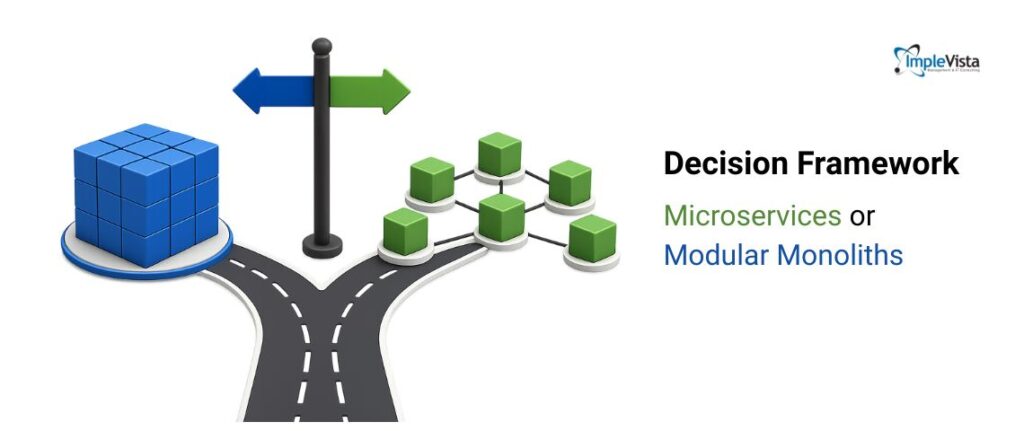
When to Choose Which Architecture
There’s no one-size-fits-all “winner” – it depends on context. Here are the guiding principles:
- Start Simple. If you’re building an MVP or a small team project, a modular monolith is usually best. It minimizes upfront complexity. You can even plan its modules so they map to potential future microservices.
- Scale Demands. As the system grows very large (think Netflix, Amazon), microservices often become necessary to handle traffic and team scale. Ask: Will parts of your app need extreme, independent scaling? If yes, microservices may be worth the cost.
- Team Size. If you have many development teams (10 or more) who must work on the system in parallel, microservices can help avoid merge conflicts and unclear ownership. Smaller teams (<10) usually move faster with a modular monolith.
- Modular Domain. If your business domain naturally splits into bounded contexts (e.g., accounting, inventory, user management), a modular monolith can let you enforce those boundaries first. Later, you could extract a module into a service if needed.
- Technical Requirements. Need different databases or languages for different parts? Microservices let you be polyglot. If you must integrate diverse technologies (e.g., legacy .NET and new Go), a microservices approach might be required.
- Risk and Cost. Starting microservices means committing to a DevOps-heavy approach (CI/CD, monitoring, logging, etc.). If budgets or expertise are limited, a modular monolith is safer.
- Existing Systems. Migrating a mature monolith is often done incrementally. Use the Strangler Fig pattern: gradually replace parts with microservices. AWS even recommends “incrementally migrating a monolith to microservices” to reduce risk. In fact, Implevista’s Cloud Engineering team guides clients through exactly this kind of transition.
Verdict at a Glance
| Choose Microservices When… | Choose a Modular Monolith When… |
| Independent scaling is essential. | Simplicity and maintainability are priorities. |
| Multiple teams need autonomous ownership. | A small or medium-sized team manages the application. |
| Different services require different technologies. | Consistency across the technology stack is preferred. |
| High fault isolation is a business requirement. | Faster development and lower operational costs are more important. |
| The organization has mature DevOps practices. | The application is still evolving, and requirements may change frequently. |
In essence, microservices are an end-game option, not a mandatory first step. Thoughtworks and others advise building a well-structured modular monoliths first and splitting it out later as needs arise. As one analysis put it, “The modular monolith provides about 90% of the microservices benefits at 10% of the operational cost.”
Implevista’s Approach
At Implevista, we tailor the architecture to client needs. Our Cloud Engineering experts often help clients move legacy apps toward microservices in stages. For new SaaS platforms, we usually start with a strong modular design. For example, our travel SaaS IV Trip is cloud-native: it uses microservices and managed APIs on the backend to power real-time booking workflows.
In consulting projects, we leverage our Development Team service (specialists in Java, .NET, Node, etc. ) so each module or service can use the best-fit technology. When cross-platform or mobile access is key, our Mobility team builds consistent UIs that consume these services. And for IoT or data-heavy projects, our IoT Solutions bridge edge devices to cloud services, often using microservices-style messaging to scale. In every case, we prioritize clear module boundaries and DevOps best practices (CI/CD, container orchestration) to ensure that whichever architecture is chosen, it scales reliably.

Which wins? There’s no knockout here—it depends on your use case. If you need rapid iteration and simplicity today, modular monoliths usually win. If your system must scale massively across teams and servers, microservices may be necessary later. The smart path is often a hybrid: start modular and single-unit, then split up gradually as needed. That way, you “get 90% of microservices’ benefits at 10% of the cost.”
Ultimately, modern enterprise development often uses both patterns together (for instance, each microservice itself might be a mini-modular monolith). The key is to align with your organization’s size, domain complexity, and engineering maturity.
Ready to architect your next project? Contact Implevista to see how our Cloud Engineering and Development Teams can guide you in choosing (or implementing) the right approach. Explore our Cloud Engineering services for cloud-native apps, learn about our Mobility and IoT solutions for scalable systems, or get in touch to discuss your needs. Want more? Subscribe to our blog for the latest in software architecture trends.
If you’re building an enterprise platform or modernizing a legacy app, talk to Implevista. Our experts can help you decide whether a microservices architecture or modular monoliths are the best fit and implement them so your software is robust, scalable, and future-proof.
FAQs: Modular Monoliths
Q1: What is a modular monolith?
A modular monolith is a single application that’s internally divided into independent modules with well-defined boundaries. Unlike a traditional monolith, each module handles its own domain and can be developed/tested separately, but all modules are deployed as one unit. This preserves simplicity (one deployment) while giving many of the organizational benefits of microservices.
Q2: How do microservices differ from modular monoliths?
Microservices are independently deployed services running in separate processes (and often on separate servers). Each microservice has its own data store and tech stack. A modular monolith keeps all code and data in one process. The key difference is deployment scope: microservices deploy each component separately, whereas a modular monolith packs all modules into one deployable system.
Q3: What is a distributed system?
A distributed system is any set of computers or services working together across a network. Microservices form a distributed system (multiple services communicate over the network), which enables scalability and resilience but also introduces complexity like network latency and partial failures.
Q4: When should I use microservices?
Use microservices when you have a large-scale system with many developers or a need for independent scalability. They make sense if parts of your app must scale differently, if teams need strict autonomy, or if you need polyglot tech stacks. Typically, you consider microservices when monolithic approaches hit performance or organizational limits.
Q5: When are modular monoliths better?
For small to medium projects, or early-stage systems, modular monoliths are usually better. They’re simpler to build, deploy, and manage. They reduce overhead while still enforcing modular design. Experts often recommend starting with a modular monolith and only moving to microservices as the project scales.
Q6: Can I convert a modular monolith to microservices later?
Yes. One advantage of modular monoliths is that well-defined modules become natural candidates for extraction. You can apply the Strangler Fig pattern: gradually replace modules by microservices over time. This incremental approach minimizes risk and disruption.
Q7: What are the downsides of microservices?
Microservices bring distributed-system challenges: more moving parts mean more complexity in networking, security, monitoring, and data consistency. They require mature DevOps, and small teams often struggle with the overhead. As one expert warns, if not done right, you end up with a distributed monolith: all the complexity for little gain.
Q8: Are modular monoliths scalable?
A well-designed modular monolith can scale to handle significant load, especially on powerful hardware. However, it scales by replicating the entire system rather than individual parts. In practice, if you reach scaling limits, you can split heavy modules into services. So modular monoliths can delay the need for distribution but eventually may need partitioning at a very large scale.
Q9: Do modular monoliths use distributed systems?
No—a modular monolith runs as one unified system, so it’s not a distributed system itself. All modules run in the same process. You only get a distributed system after you break out a module into a separate service that communicates over a network. That’s why modular monoliths avoid network overhead—there is no inter-service call.
Q10: How do I decide which architecture is right for my enterprise?
It depends on your team size, project stage, and non-functional requirements. For most new enterprise apps, start modular: design clear boundaries (possibly aligning with domain-driven design) and build a single deployable system. Monitor how the load and teams grow. If parts of the app become bottlenecks or teams conflict, plan a gradual migration to microservices. Consulting firms like Implevista can help analyze your situation, considering business goals and technical constraints, to make the best choice.