
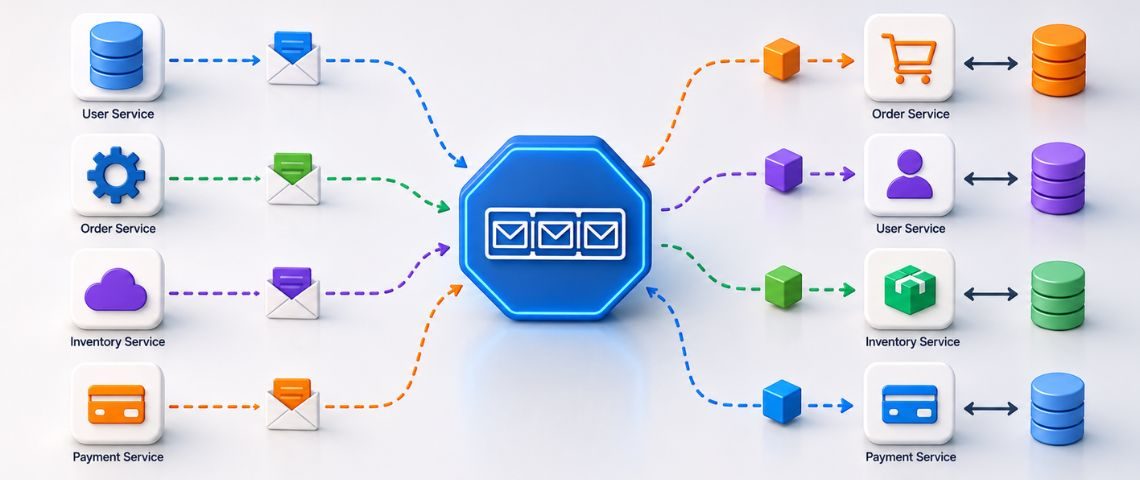
Picture a busy airport control tower. Planes are landing, taking off, refueling, and rerouting around the weather every few minutes. No single controller waits around asking, “Has anything changed yet?” Instead, every change — a delayed flight, an open runway, a fuel truck arriving — gets broadcast the moment it happens, and every system that cares about it reacts instantly.
That’s essentially how event driven architecture works, except instead of planes, it’s your order confirmations, payment approvals, inventory updates, and customer notifications.
If you’ve ever wondered why apps like Uber, Amazon, and your banking app can react to changes the instant they occur—rather than making you refresh the page—the answer is almost always event driven architecture (EDA). It’s quietly become one of the most important software design patterns of the last decade, and in 2026, it’s the backbone of everything from e-commerce platforms to AI agents.
In this guide, we’ll break down what event driven architecture actually means, how it works, why it matters for real-time data processing and microservices communication, and how businesses—including our own clients at Implevista—are putting it to work.
What Is Event Driven Architecture?
So, what is event driven architecture, exactly? In plain terms, event-driven architecture is a software design pattern in which different parts of a system communicate by producing and reacting to “events”—small, discrete records of something that just happened—rather than constantly asking each other for updates.
An event could be almost anything:
- A customer places an order
- A sensor detects a temperature change
- A payment gets approved
- A user updates their shipping address
- A flight seat becomes available
In a traditional system, one piece of software would usually have to call another directly and wait for a response—a model known as “request-response.” In an event driven architecture, the part of the system that creates the event (the “producer”) simply publishes it. It doesn’t know or care who’s listening. Any number of other systems (the “consumers”) can pick up that event and act on it independently, at their own pace.
This single shift — from “ask and wait” to “announce and react” — is what makes event-driven systems so much more scalable, flexible, and responsive than traditional designs.
How Event Driven Architecture Works
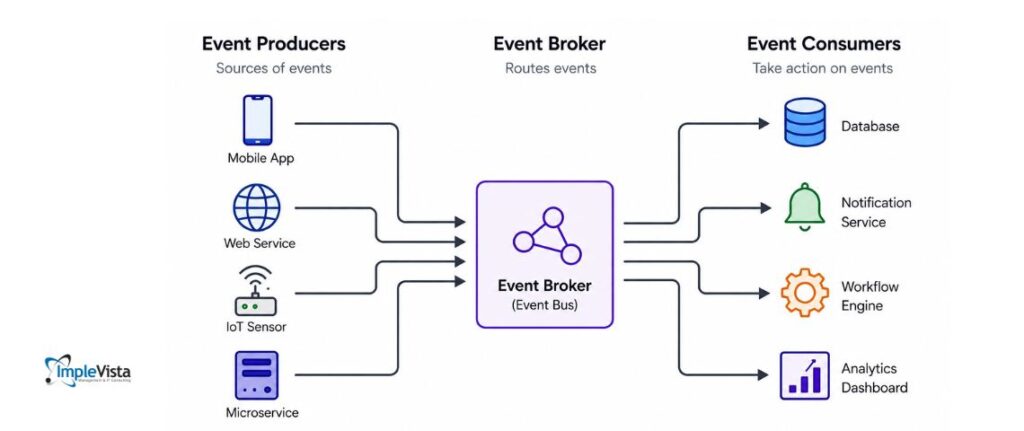
At a high level, every event-driven system is built from three moving parts working together continuously.
Core Components: Producers, Brokers, and Consumers
- Event Producers – These are the sources of events: a mobile app, a web service, an IoT sensor, a payment gateway, or even another microservice. A producer’s only job is to detect that something happened and publish it as an event.
- Event Broker (or Event Bus) – This is the middleman. Tools like Apache Kafka, Amazon EventBridge, RabbitMQ, or Google Pub/Sub receive events from producers and route them to whichever consumers need them. The broker decouples producers from consumers entirely—neither has to know the other exists.
- Event Consumers – These are the services that subscribe to specific types of events and take action when they occur: updating a database, sending a notification, triggering a workflow, or feeding a real-time analytics dashboard.
Notice that the order service that created the event has no idea how many systems are listening or what they do with the information. That’s the heart of loose coupling, and it’s what makes event driven architecture so resilient—you can add, remove, or update consumers without touching the producer at all.
Event-Driven vs. Request-Response Architecture
It’s easier to understand event driven architecture by comparing it with the traditional request-response model most developers grew up with.
| Aspect | Request-Response Architecture | Event-Driven Architecture |
| Communication style | Synchronous (caller waits for a reply) | Asynchronous (fire-and-forget) |
| Coupling | Tightly coupled services | Loosely coupled services |
| Scalability | Limited by the slowest service in the chain | Each service scales independently |
| Failure impact | One failure can block the entire chain | Failures are isolated and easier to contain |
| Best suited for | Simple CRUD apps, direct lookups | Real-time systems, microservices, IoT, analytics |
Neither approach is “better” in every situation—plenty of simple applications still work perfectly well with request-response. But once a system needs to react to dozens (or millions) of changes happening simultaneously across multiple services, event driven architecture becomes the more practical choice. As IBM notes, EDA is built specifically around the publication, capture, processing, and storage of events so teams can detect and respond to changes in real time or near-real time.
Benefits of Event Driven Architecture
Let’s get into the benefits of event driven architecture in concrete terms, because “scalability” and “flexibility” can sound abstract until you see what they actually solve.
- Scalability – Producers and consumers scale independently. If your checkout service suddenly needs to handle ten times the traffic during a sale, you scale just that service, not the entire application.
- Loose coupling – Services don’t need direct knowledge of each other, which means you can add new features (like a new notification channel) without rewriting existing code.
- Resilience and fault tolerance – A failure in one consumer doesn’t bring down the producer or other consumers. Events can be retried, queued, or replayed once the failed service recovers.
- Faster time-to-market – Teams can build and ship new features (a new dashboard, a new integration, a new automation) without waiting on other teams to finish their part of the system.
- Real-time responsiveness – As covered above, decisions and reactions happen the moment data changes, not after a delay.
- Better resource efficiency – Event-driven systems are push-based rather than constantly polling for updates, which reduces unnecessary network traffic and compute costs.
- Audit trail and traceability – Because events represent a record of everything that happened, many teams use them to reconstruct system state for debugging, compliance, or analytics—a pattern known as event sourcing.
Industry research backs this up: a growing majority of global enterprises have already adopted event-driven patterns in some form, and most of those that have say they intend to expand EDA use across the wider organization rather than scale it back. That’s a strong signal that this isn’t a passing trend — it’s becoming the default way modern systems are built.
Event Driven Architecture and Microservices Communication
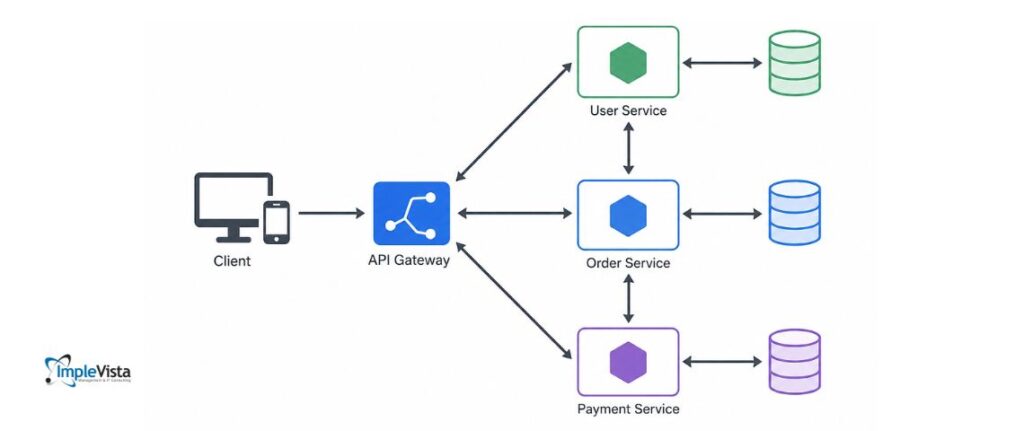
If you’ve already broken your application into microservices, you’ve probably run into the next problem: how do all these independent services talk to each other without becoming a tangled mess of direct API calls?
This is exactly where microservices communication benefits most from an event-driven approach. Instead of Service A calling Service B, which calls Service C, which waits on Service D (a chain that breaks the moment one service goes down), each service simply publishes events about what it has done and subscribes to the events it cares about.
The advantages of microservices communication are significant:
- Independent deployment – Teams can update, redeploy, or scale individual services without coordinating releases with every other team.
- Fault isolation – If the email notification service goes down, it doesn’t take down order processing or payments with it.
- Easier scaling – High-traffic services (like an inventory checker during a flash sale) can scale up independently of lower-traffic ones.
- Technology flexibility – Each microservice can use whatever language, framework, or database fits the job, since communication happens through standardized events rather than tightly coupled APIs.
We’ve written in more depth about how teams should weigh this decision in our blog post comparing microservices versus modular monoliths, which is a useful read if you’re still deciding how granular your architecture should be before introducing event-driven patterns. For teams that are further along and already running distributed services, our cloud engineering services team can help design the event infrastructure that ties everything together reliably.
Common Event Driven Architecture Patterns
Not all event-driven systems are built the same way. Here are the patterns you’ll run into most often.
- Publish/Subscribe (Pub/Sub)
The most common pattern. Producers publish events to a “topic,” and any number of consumers can subscribe to that topic without the producer knowing who’s listening. This is the simplest entry point into event-driven architecture and works well for notifications, fan-out workflows, and decoupled microservices.
- Event Streaming
Instead of single, isolated events, an event stream is a continuous, ordered flow of events — think of it as a live feed rather than a one-off announcement. Apache Kafka is the most widely used platform for this pattern, and it’s especially useful when you need to replay historical events or process large volumes of data in order.
- Event Sourcing
Here, every change to an application’s state is stored as an immutable event in an append-only log, rather than simply overwriting a database record. The current state is calculated by replaying the events. This gives you a complete history and the ability to “rewind” a system to any point in time—extremely valuable in finance, auditing, and compliance-heavy industries, though it does add architectural complexity.
- CQRS (Command Query Responsibility Segregation)
Often paired with event sourcing, CQRS separates the “write” side of an application (commands that change data) from the “read” side (queries that retrieve data). This allows each side to be optimized and scaled independently, which is especially helpful in high-traffic systems where reads vastly outnumber writes.
Real-Time Data Processing With Event Driven Architecture
The other secondary keyword we promised to cover—real-time data processing—is arguably the single biggest reason businesses adopt event driven architecture in the first place.
In a traditional batch-processing setup, data is collected over a period of time (an hour, a day, sometimes a week) and processed all at once. That’s fine for end-of-month reports, but it’s far too slow for fraud detection, live inventory tracking, personalized recommendations, or anything where a delay of even a few minutes costs money or trust.
Event driven architecture flips this on its head. Because every change is published as an event the instant it happens, downstream systems can process that data immediately — not in a batch, not on a schedule, but in real time.
This matters enormously for:
- E-commerce – Updating stock levels and prices the moment an item sells, instead of overselling popular products.
- Finance and banking – Flagging suspicious transactions as they occur, not after a daily reconciliation job.
- IoT and manufacturing – Reacting to a sensor reading (like an overheating machine) within milliseconds rather than discovering the problem hours later.
- Travel and booking systems – Reflecting live flight, hotel, and seat availability as it changes across multiple supplier APIs.
- Marketing and customer analytics – Updating dashboards and triggering personalized offers based on what a customer is doing right now.
This is also where IoT and analytics services tend to intersect with event-driven design. Our IoT solutions team builds sensor networks that generate continuous event streams, while our business analytics practice helps turn that real-time data into dashboards decision-makers can actually use. If your marketing team also needs to track how real-time site and campaign data feeds into reporting, it’s worth looking at how web analytics ties into the same event streams powering your product.

Real-World Use Cases of Event Driven Architecture
Theory aside, here’s where event driven architecture actually shows up in production systems today:
- E-commerce platforms – Order placement, inventory updates, abandoned cart triggers, and personalized recommendations all run on event streams. If you’re exploring this for your own store, our e-commerce development service is built around exactly this kind of real-time, event-driven backend.
- Travel and booking software – Travel platforms need to reflect live availability across multiple external systems simultaneously. Our own travel agency platform, IV Trip, is a good example: it integrates real-time flight, hotel, and package data from multiple global distribution systems, and event-driven patterns are exactly what keep pricing, seat availability, and booking confirmations accurate across web and mobile in real time.
- Banking and fintech – Fraud detection, real-time balance updates, and instant payment confirmations.
- Logistics and supply chain – Tracking shipments, triggering reorders automatically when stock crosses a threshold, and coordinating warehouse robotics.
- SaaS platforms – Usage-based billing, in-app notifications, and audit logging across multi-tenant systems. If you’re scaling a SaaS product, our piece on building SaaS architecture for high-growth platforms digs deeper into how event-driven design supports that growth.
- Serverless and cloud-native applications – Event-driven design is the natural fit for serverless functions, which only run when triggered by an event. We cover this connection in more detail in our article on serverless and cloud-native architectures.
Challenges and Best Practices for Implementing EDA
It would be misleading to present event driven architecture as a silver bullet. It solves real problems, but it introduces new ones too, and being upfront about that is part of doing this well.
Common challenges:
- Increased complexity – Tracing a single transaction across a dozen decoupled services is harder than following a linear call stack. You’ll need proper logging, distributed tracing, and monitoring from day one.
- Eventual consistency – Because consumers process events asynchronously, different parts of your system may be briefly “out of sync” with each other. Most applications can tolerate this, but it requires careful design for anything involving money or inventory.
- Schema management – As your system grows, event formats inevitably need to change. Without strict versioning, you risk breaking consumers who weren’t updated in time.
- Debugging difficulty – With no single linear flow to follow, troubleshooting “why didn’t this event get processed” requires good tooling and discipline.
- Operational overhead – Running a message broker reliably at scale (handling retries, dead-letter queues, and failover) is a real engineering investment.
Best practices that make a real difference:
- Start small — introduce event-driven patterns for a single high-value workflow before rearchitecting the entire system.
- Document every event schema clearly and version them from the start.
- Build idempotent consumers, so processing the same event twice doesn’t cause duplicate side effects (like double-charging a customer).
- Invest in observability tools (distributed tracing, centralized logging, dead-letter queue alerts) before you need them, not after an incident.
- Choose your broker based on actual volume and complexity, not hype—a smaller team with modest traffic often doesn’t need the operational overhead of a full Kafka cluster.
How Implevista Helps Businesses Adopt Event Driven Architecture
At Implevista, we’ve helped clients across e-commerce, travel, fintech, and SaaS move from rigid, request-response systems to flexible event driven architectures that scale with their growth. Whether that means breaking apart a monolith into well-designed microservices, building real-time IoT data pipelines, or architecting the cloud infrastructure that holds it all together, our development team works alongside your in-house engineers to design systems that won’t need to be rebuilt from scratch every time your traffic doubles.
You can see how this approach has played out for past clients in our case studies, where real-time responsiveness and scalable architecture have been recurring themes across different industries.
Frequently Asked Questions
- What is event driven architecture in simple terms?
Event driven architecture is a way of designing software where different parts of a system communicate by publishing and reacting to “events”—records of something that just happened — instead of directly calling and waiting on each other.
- What are the main benefits of event driven architecture?
The biggest benefits of event-driven architecture include scalability, loose coupling between services, faster real-time responsiveness, better fault tolerance, and the flexibility to add new features without disrupting existing systems.
- Is event driven architecture the same as microservices?
No. Microservices describe how you split an application into independent services; event driven architecture describes how those services communicate. They’re commonly used together, but you can have microservices without EDA, and EDA can be used with non-microservice systems too.
- What is the difference between event-driven and request-response architecture?
Request-response is synchronous — one service calls another and waits for a reply. Event driven architecture is asynchronous—a service publishes an event and moves on, letting any number of other services react independently and at their own pace.
- What tools are used to build event driven architecture?
Common tools include Apache Kafka, Amazon EventBridge, RabbitMQ, Google Cloud Pub/Sub, Azure Event Grid, and Apache Pulsar, depending on the scale and complexity of the system.
- Is event driven architecture good for small businesses or startups?
It can be, but it’s not always necessary. If you have a small team and modest traffic with only one consumer per event, a simpler message queue (or even a traditional API) may serve you better. EDA pays off most when you have multiple services or teams that need to react to the same events independently.
- How does event driven architecture support real-time data processing?
Because events are published the instant something happens, consumers can process and react to that data immediately rather than waiting for a scheduled batch job, which is exactly what real-time data processing requires.
- What industries benefit most from event driven architecture?
E-commerce, banking and fintech, travel and hospitality, logistics, IoT and manufacturing, and SaaS platforms see some of the biggest gains, since all of them depend on reacting quickly to constantly changing data.
- What are the risks or downsides of event driven architecture?
The main downsides are added system complexity, harder debugging across distributed services, eventual consistency (brief delays before all parts of the system agree on the current state), and the operational work needed to run a reliable event broker.
- How do I get started with event driven architecture for my business?
Start with one high-value workflow — like order processing or real-time notifications — rather than rearchitecting your entire system at once. Working with an experienced development partner can help you choose the right tools and avoid common pitfalls early on.
Event-driven architecture isn’t just a technical trend — it’s a fundamentally different way of thinking about how software should respond to the world around it. Instead of systems that sit and wait to be asked, you get systems that notice, react, and adapt the moment something changes. For businesses competing on speed, personalization, and real-time customer experience, that difference is no longer optional — it’s becoming the baseline expectation.
If you’re evaluating whether event-driven architecture is right for your business or you’re ready to modernize an existing system, our team at Implevista would be glad to help you map out the right approach. Get in touch with our team to discuss your project, or explore our development services to see how we support businesses building scalable, real-time systems. You can also subscribe to our blog for more deep dives into modern software architecture or read our related guide on composable architecture for another angle on building flexible, future-proof systems.