
ERP Software Bangladesh: Cost, Modules, Implementation & How to Choose
If you run a business in Dhaka, Chattogram, or anywhere else in Bangladesh, chances are you’ve felt the pain of disconnected systems. Sales sits in one spreadsheet. Inventory lives in another. Accounting is handled by a separate desktop tool that only one person in the office actually knows how to use. Nobody has the full picture, and every month-end close feels like solving a puzzle with half the pieces missing.
That’s the exact gap that ERP Software Bangladesh solutions are built to close.
Enterprise Resource Planning (ERP) systems bring your finance, inventory, sales, HR, and operations data into one connected platform. Instead of chasing numbers across five different tools, you get one real-time source of truth. For a growing business, that’s not a luxury; it’s the difference between scaling smoothly and drowning in operational chaos.
Demand for ERP software in Bangladesh has grown quickly over the past few years, as more SMEs, manufacturers, and distributors realize spreadsheets can’t keep pace with a scaling operation. But choosing an ERP system isn’t simple. The market is crowded, pricing is often vague until you’re deep into a sales call, and every vendor claims to be the “best ERP software for businesses in Bangladesh.” This guide cuts through that noise. We’ll walk through what ERP actually does, what it costs in the Bangladeshi market, how implementation works, and exactly how to choose a system and a provider that fits your business rather than the other way around.
What Is ERP Software, and Why Does It Matter for Bangladeshi Businesses?
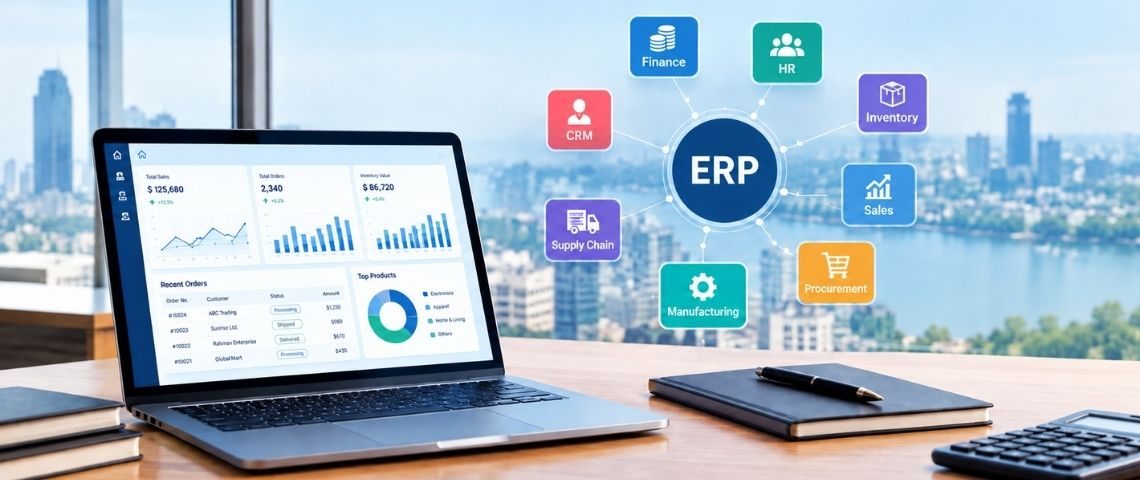
At its core, an ERP system is a piece of business management software that connects the different departments of a company into a single digital backbone. Instead of finance, sales, warehousing, and HR each running on their own tools, everything reports into one database that everyone can see and trust. In practice, most ERP software buyers in Bangladesh evaluate their options against one simple question: does it actually reduce the daily back-and-forth between departments, or does it just add another login to remember?
According to HubSpot’s guide to ERP software, modern ERP platforms have moved well beyond their manufacturing-only origins and now serve retail, services, e-commerce, and distribution businesses of every size, which happens to be exactly the mix of industries driving Bangladesh’s economy today.
For local businesses specifically, ERP adoption tends to solve a very familiar set of headaches:
- Manual, error-prone reconciliation between sales registers, bank statements, and accounting books
- No real-time visibility into stock levels across multiple warehouses or retail outlets
- Disconnected teams where sales doesn’t know what production is doing, and finance finds out about a big order after the fact
- Compliance and reporting delays that make it hard to respond quickly to tax authorities, auditors, or investors
- Growth bottlenecks where adding a new branch, product line, or sales channel means adding more spreadsheets rather than more capacity
As Bangladesh’s SME and mid-market sector continues to formalize and digitize, ERP is quickly shifting from a “nice to have” for large conglomerates to a practical necessity for any business serious about scaling. This is exactly why interest in ERP software in Bangladesh has moved from IT departments to boardrooms; it’s increasingly seen as a growth decision, not just a technology one.

ERP Software for Growing Businesses: Signs You’re Ready
Not every business needs an ERP system on day one. But there are clear signals that tell you it’s time to stop patching things together with spreadsheets and start looking at proper ERP solutions for businesses. Good ERP software for growing businesses is designed to scale with you, so the system you choose today shouldn’t need replacing the moment you open a second location.
You’re likely ready to invest in ERP software in Bangladesh if:
- Your team spends more time compiling reports than acting on them. If someone has to manually pull numbers from four systems just to build a weekly sales report, that’s time you’re paying for that isn’t moving the business forward.
- You’ve outgrown your accounting software. Tools built for basic bookkeeping (like simple invoicing apps) buckle once you add multi-location inventory, manufacturing, or multi-currency transactions.
- You’re opening new branches or sales channels. Every new location without centralized systems multiplies your operational risk.
- Inventory discrepancies are a recurring problem. If your books say one thing and your warehouse shows another, you’re losing money somewhere in that gap.
- Decision-making feels reactive rather than proactive. Leadership finds out about problems weeks after they happen instead of catching them in real time.
If two or more of these sound familiar, it’s worth exploring what enterprise software actually looks like for a Bangladeshi business in 2026 before your operational debt gets more expensive to unwind. The earlier you invest in ERP software for growing businesses, the less painful the eventual migration from spreadsheets becomes.
ERP Solutions for Businesses: Core Modules Explained
Every ERP system is built from modules, self-contained functional blocks that plug into the central database. Understanding these modules is the fastest way to evaluate whether a given ERP solution actually covers what your business needs or whether you’ll end up patching gaps with third-party tools anyway. Most ERP Software Bangladesh packages are sold in modular tiers for exactly this reason, so you only pay for the functionality your business actually uses today.
- Finance and Accounting: This is the heart of almost every ERP deployment. It covers general ledger, accounts payable and receivable, budgeting, bank reconciliation, and financial reporting. A strong finance module should support Bangladeshi tax and VAT requirements out of the box, not as an expensive add-on.
- Inventory and Warehouse Management: Real-time stock tracking across multiple warehouses, batch and expiry tracking, reorder alerts, and barcode support. For distribution and retail businesses, this module alone often justifies the entire ERP investment.
- Sales and CRM manage your sales pipeline, quotations, order processing, and customer relationship history. A well-integrated CRM inside your ERP means sales and finance are always looking at the same customer data, so there are no more “the invoice doesn’t match the quote” arguments.
- Procurement and supply chain purchase requisitions, vendor management, purchase orders, and supplier performance tracking. This module reduces the back-and-forth email chains that usually govern procurement in smaller businesses.
- Human Resources and Payroll Employee records, attendance, leave management, and payroll processing; increasingly important as labor compliance in Bangladesh becomes more formalized.
- Manufacturing and Production Planning: For manufacturers: This covers bill of materials (BOM), production scheduling, shop floor tracking, and quality control. It’s what separates a true ERP from a glorified accounting package.
- Business Intelligence and Reporting: Dashboards and analytics that turn raw transactional data into decisions. This is often the module leadership cares about most, even if it’s the one operations teams interact with least.
For a deeper breakdown of which of these matter most for smaller teams, Implevista’s blog has a dedicated piece on the top 10 ERP modules every SME should consider; it’s worth a read before you finalize your requirements list.
ERP Software Bangladesh Cost: What You’ll Actually Pay
This is usually the question business owners want answered first, and it’s also the one vendors are most evasive about. Let’s fix that, because ERP Software Bangladesh pricing varies more than most first-time buyers expect.
Factors That Influence ERP Pricing
Several variables drive the final number on your ERP invoice:
- Deployment model: cloud/SaaS ERP typically has lower upfront costs but ongoing subscription fees; on-premises ERP has higher upfront costs but no recurring license fees.
- Number of users and modules: most ERP vendors price per user, per module, or a combination of both.
- Customization level: a system that maps closely to your existing workflows costs less than one requiring heavy custom development.
- Data migration complexity: moving years of historical data from spreadsheets or legacy systems into a new ERP takes time and specialist effort.
- Integration requirements: connecting your ERP to your e-commerce store, POS system, or existing accounting software adds engineering work.
- Training and change management: often underestimated, but critical to actual adoption once the system goes live.
Typical Cost Ranges by Business Size
While global enterprise ERP platforms like SAP S/4HANA or NetSuite can run into hundreds of thousands of dollars once implementation is included, that’s rarely the right benchmark for a Bangladeshi SME. Locally built or regionally deployed ERP solutions, including custom-built platforms from providers based in Bangladesh, tend to be significantly more cost-efficient because development and support costs are lower and the system is scoped to your actual operational size, not a generic global template.
As a rough framework:
| Business Profile | Typical Investment Range | What’s Usually Included |
| Small business / single location | Lower five-figure BDT range annually | Core finance, inventory, basic reporting |
| Growing SME / multi-branch | Mid five-figure to low six-figure BDT range | Finance, inventory, CRM, HR, custom workflows |
| Mid-market / manufacturing | Higher six-figure BDT range and up | Full module suite, production planning, integrations |
These figures are illustrative starting points, not fixed quotes. Actual pricing depends heavily on the factors listed above and should always be confirmed directly with your chosen provider.
Hidden Costs to Budget For
Beyond the license or subscription fee, budget for:
- Data migration and cleanup
- Custom integrations (e-commerce, payment gateways, banking APIs)
- Employee training time
- Ongoing support and maintenance contracts
- Periodic upgrades or module additions as you grow
If you want a sense of how software project pricing generally works in the local market, Implevista’s guide to software development cost in Bangladesh breaks down the variables that apply just as much to ERP software Bangladesh builds as to any custom software project.
Cloud vs On-Premise ERP: Which Deployment Fits Your Business?
This decision shapes almost everything else about your ERP experience, so it’s worth getting right early.
Cloud ERP (SaaS)
- Lower upfront investment, predictable monthly or annual subscription
- Vendor handles servers, security patches, and uptime.
- Accessible from anywhere; useful if you manage multiple branches or a remote team
- Faster to deploy, generally within weeks rather than months
On-Premise ERP
- Higher upfront cost, but no recurring license fee over time
- Full control over your data and infrastructure; a common requirement for businesses in regulated industries or those with strict data residency preferences
- Requires in-house or contracted IT support to maintain
- Slower to update, but more customizable at the infrastructure level
For most growing Bangladeshi SMEs, cloud ERP tends to be the more practical starting point: lower risk, faster time to value, and easier to scale as headcount grows. Larger manufacturers or businesses with heavy compliance requirements sometimes still prefer on-premises or hybrid setups. Either way, this is one of the first architectural decisions any ERP Software Bangladesh buyer has to make, since it shapes cost, timeline, and internal IT requirements for years afterward.
ERP Implementation Process: A Step-by-Step Roadmap
Buying the software is the easy part. Implementation is where most ERP projects succeed or quietly fail. Here’s a realistic ERP Software Bangladesh implementation roadmap that avoids the usual delays:
- Requirements gathering and process mapping. Document your current workflows before you touch a single system setting. You can’t automate a process nobody has clearly defined.
- Vendor and system selection. Shortlist providers based on module fit, industry experience, and, critically, their track record supporting businesses of your size in Bangladesh.
- Solution design and configuration. Map your business processes onto the ERP’s structure, deciding what’s configured out-of-the-box versus what needs custom development.
- Data migration. Clean and transfer your historical data, including customer records, inventory counts, and financial history, into the new system. This step is chronically underestimated and deserves extra time in your project plan.
- Integration. Connect the ERP to your existing tools: e-commerce storefronts, POS terminals, payment gateways, or banking systems.
- Testing. Run parallel testing against your old systems before fully switching over, so discrepancies get caught before go-live, not after.
- Training and change management. Your team needs to actually use the system correctly for it to deliver value. Budget real time for this, not just a one-hour demo session.
- Go-live and post-launch support. The first few weeks after launch are when most issues surface. A responsive support arrangement with your provider matters more here than almost anywhere else in the project.
Most SME-scale ERP implementations in Bangladesh take anywhere from 8 to 20 weeks depending on complexity, number of modules, and how much custom development is required.
How to Choose the Best ERP Software for Businesses in Bangladesh
With the groundwork covered, here’s how to actually evaluate your options. Finding the best ERP software for businesses in Bangladesh isn’t about picking the platform with the most features; it’s about picking the one that fits how your team already works.
Business Management Software vs. Point Solutions
A common mistake is stitching together separate point solutions, one tool for accounting, another for inventory, and a third for HR, and calling it “good enough.” It often works fine at a small scale, but every additional disconnected tool adds a new place for data to go out of sync. True business management software (i.e., an actual ERP) removes that risk by keeping everything in one database from day one. If you’re currently running multiple disconnected tools, that’s usually the clearest sign you’ve outgrown the point-solution approach.
Checklist for Choosing the Right ERP
Use this checklist as a practical filter when comparing ERP solutions for businesses in your shortlist:
- Does it match your industry? Manufacturing, retail, and services businesses have very different core workflows; make sure the modules reflect that.
- Does it support local compliance requirements? VAT reporting, local tax formats, and Bangla-language support (where relevant) matter more than most global vendors realize.
- Is it scalable? Choose a system that can grow with you, from a single branch to multiple locations, from a single vendor to a multi-vendor if relevant to your model.
- What does total cost of ownership look like over 3–5 years, not just the first-year price tag?
- How responsive is post-launch support? Ask for real client references, not just case studies on the vendor’s website.
- Can it integrate with the tools you already depend on: your e-commerce platform, your accounting exports, and your payment gateways?
How to Choose the Right ERP Solution Provider in Bangladesh
The software matters, but the provider implementing it often matters more. Two businesses running the same ERP platform can have completely different experiences depending on who configured it, trained their team, and answers the phone when something breaks. This is arguably the most overlooked step when choosing ERP software in Bangladesh; buyers spend weeks comparing features and days (or hours) vetting the provider.
When evaluating an ERP solution provider, look for:
- Local presence and market experience. A provider that understands Bangladeshi business practices, tax rules, and operational realities will configure the system more accurately than one working purely off generic templates.
- A track record across relevant industries, ideally with case studies you can actually review, not just logos on a homepage.
- Transparent, itemized pricing rather than vague quote-based numbers that shift once you’re already committed.
- In-house development capability, not just resale of a third-party license; this matters when you eventually need custom workflows or integrations that off-the-shelf configuration can’t cover.
- Post-implementation support structure: SLAs, response times, and whether support is local or routed through an overseas call center.
Implevista has been building and implementing enterprise systems, including SAP services and custom ERP builds, for businesses across telecom, pharmaceuticals, manufacturing, and retail for years, working from its base in Dhaka with a broader footprint across South Asia and Europe. You can review the kind of engagements the team has delivered on the case studies page, or look directly at the SAP services offering if your business is already leaning toward an SAP-based deployment.
Common ERP Implementation Mistakes to Avoid
Even with the right software and the right provider, projects can still go sideways. Across every ERP Software Bangladesh implementation we’ve been part of, the same handful of pitfalls keep showing up:
- Skipping proper process mapping and trying to configure the system before anyone agrees on how the business actually operates today.
- Underestimating data migration effort. Messy historical data doesn’t get cleaner just because it’s moving to a new system.
- Treating training as an afterthought. A powerful ERP used incorrectly delivers less value than a simple spreadsheet used well.
- Choosing the cheapest quote without checking scope. Low upfront pricing sometimes hides missing modules or minimal support, so read the fine print.
- No internal project owner. Every successful ERP rollout has someone internally accountable for the project, not just the vendor driving it from the outside.
- Ignoring change management. Employees resist new systems when they don’t understand why the change is happening. Communicate the “why,” not just the “how.”
According to widely cited industry research summarized by analysts like Gartner, a significant share of ERP projects run over budget or past their original timeline, almost always due to scope and change-management issues rather than the software itself. Planning around these failure points from day one is the single highest-leverage thing you can do for your project’s success.
Why Implevista Is a Trusted ERP Solutions Provider in Bangladesh
Implevista has spent years helping Bangladeshi and international businesses turn operational bottlenecks into competitive advantages through SAP implementation, custom ERP builds, and integrated business systems designed around how local companies actually operate. As a hands-on ERP Software Bangladesh provider, the team configures systems around real operational workflows rather than forcing your business to adapt to a rigid template.
Beyond core ERP and SAP services, Implevista’s broader product ecosystem reflects the same philosophy of connected, purpose-built software:
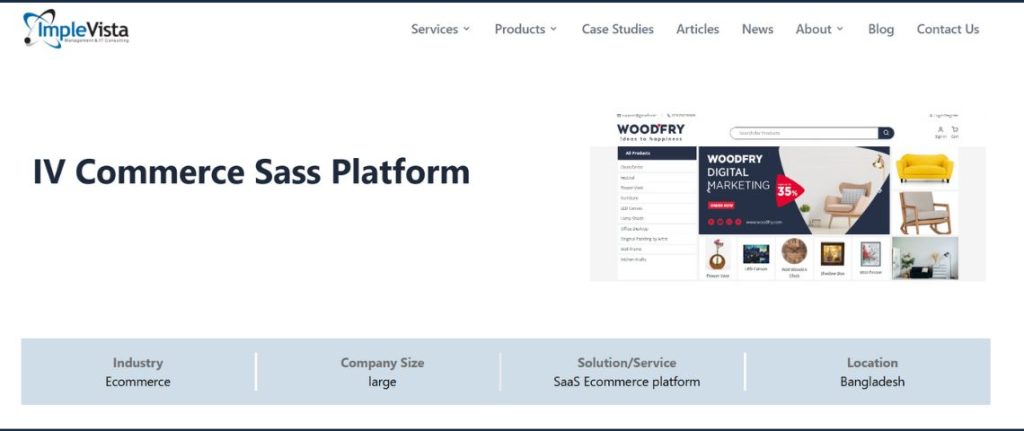
- iVCommerce: A centralized e-commerce management platform for B2B, B2C, and multi-vendor businesses for companies that need their online store connected to the same operational backbone as the rest of the business.
- iQuidi: Accounting software purpose-built for SMEs that need financial clarity without enterprise-level complexity, explored further in this piece on accounting for SME features that boost growth.
- Business Analytics services: For businesses that already have an ERP in place but need better reporting and decision-making tools layered on top.
Whether you’re implementing your first ERP system or replacing a platform that’s outgrown your business, working with a provider who understands both the technology and the Bangladeshi market context saves time, money, and a lot of avoidable frustration.
ERP software isn’t just a back-office upgrade; it’s the operational foundation that lets a growing Bangladeshi business scale without losing control of its finances, inventory, or customer relationships. The right system, implemented by the right provider, replaces guesswork with real-time visibility and replaces scattered spreadsheets with a single source of truth.
The cost, module mix, and implementation timeline will look different for every business, but the fundamentals covered in this guide give you a solid framework to evaluate any ERP Software Bangladesh option and any provider you’re considering.
Ready to explore what an ERP system could look like for your business? Contact Implevista’s team for a consultation, or explore the full range of Implevista’s e-commerce and ERP-adjacent solutions to see how a connected system could fit your operations. You can also subscribe to Implevista’s blog for ongoing insights on enterprise software, digital transformation, and technology decisions relevant to Bangladeshi businesses.
Frequently Asked Questions
- What is ERP software, in simple terms?
ERP (Enterprise Resource Planning) software is a system that connects your business’s core functions—finance, inventory, sales, HR, and more—into one platform, so everyone works from the same real-time data instead of separate spreadsheets or disconnected tools.
- How much does ERP Software Bangladesh typically cost?
Costs vary widely based on business size, number of users, and modules required. Small businesses can expect lower five-figure BDT investments annually, while mid-market or manufacturing businesses with more complex needs should budget significantly higher. Always request a detailed, itemized quote rather than relying on a single headline number.
- What are the most important ERP modules for a small business?
Most SMEs start with finance and accounting, inventory management, and sales/CRM modules, then add HR, procurement, or manufacturing modules as the business grows.
- How long does ERP implementation take?
For most SME-scale projects in Bangladesh, implementation typically takes 8 to 20 weeks, depending on the number of modules, data migration complexity, and how much customization is required.
- Is cloud ERP better than on-premise ERP for a growing business?
Cloud ERP is generally more practical for growing SMEs due to lower upfront costs, faster deployment, and easier scalability. On-premise ERP can make sense for businesses with strict data residency needs or heavy customization requirements.
- What’s the difference between ERP and CRM?
CRM manages customer-facing activities like sales pipelines and marketing; ERP manages the operational and financial back office, including accounting, inventory, and procurement. Many modern ERP systems include CRM as one of their modules.
- Can ERP software integrate with an existing e-commerce store?
Yes. Most modern ERP systems support integration with e-commerce platforms so that orders, inventory, and customer data sync automatically between your online store and your back-office systems.
- What’s the biggest reason ERP implementations fail?
Poor planning around change management and unclear internal ownership of the project, not the software itself, are the most common reasons ERP rollouts underdeliver or run over budget and timeline.
- Do I need a local ERP solution provider, or can I use an international vendor directly?
A local provider familiar with Bangladeshi tax rules, business practices, and support expectations typically delivers a smoother implementation and faster ongoing support than working directly with an overseas vendor with no local presence.
- How do I know if my business is ready for ERP software?
If your team spends more time compiling reports than analyzing them, you’re facing recurring inventory discrepancies, or you’re expanding to new locations without centralized systems, those are strong signals it’s time to evaluate ERP software for your business.