

What is Composable Architecture? The Ultimate Business and Technical Guide
Welcome to the inaugural edition of our Modern Software Architecture Series, where we break down the leading design concepts reshaping enterprise technology. In today’s hyper-fast digital landscape, operational agility is a core survival mechanism. For decades, businesses relied on traditional, monolithic software environments where everything was bound together in a single codebase. While these all-in-one systems worked well when requirements remained static, they cannot keep pace with modern demands. Today, consumer preferences shift overnight, and new technologies emerge monthly; if your software platform takes six months of complex development just to deploy a single feature, your business is falling behind.
This bottleneck is why modern enterprises are moving away from restrictive platforms and embracing a paradigm shift that redefines how applications are designed, built, and scaled. But what is composable architecture, and why is it becoming the gold standard for global software development? In this guide—the first of our series—we will break down the fundamental mechanics of a modular software architecture, explore its business benefits, and demonstrate how moving toward a scalable software architecture future-proofs your digital operations.
Understanding the Shift: From Monoliths to Modular Software Architecture
To truly appreciate the value of a composable approach, we must first look at what came before it. For years, the enterprise software market was dominated by legacy systems built as a monolith—meaning the user interface, database access layer, business logic, and payment processing are all tightly coupled into a single, massive codebase.
While monoliths are easy to launch initially, they introduce severe bottlenecks as your business grows:
- High Risk of Instability: Because all components are intertwined, a minor change or bug in one section (like the payment gateway) can accidentally break an entirely unrelated feature (like the product recommendation engine).
- Inefficient Resource Scaling: Scaling the system requires replicating the entire monolithic stack in the cloud, which wastes computing resources and dramatically drives up infrastructure costs.
- Maintenance Bottlenecks: Making even minor updates requires deploying the whole codebase, which slows down development teams and delays critical releases.
A modular software architecture solves these issues by breaking the application down into independent, loosely coupled building blocks. Instead of operating as a rigid, single unit, your software becomes an ecosystem of specialized services that communicate through standardized APIs. This means you can update your inventory tracking system independently, without touching your customer reviews module or your frontend presentation layer.
What is Composable Architecture?
At its core, composable architecture is a design philosophy where an application’s components are entirely decoupled, independent, and pluggable. Instead of buying or building a single, massive software suite that tries to do everything mediocrely, businesses select best-of-breed components for specific tasks and compose them into a cohesive system.
Think of it like building with LEGO bricks. Each brick has a specific shape and function, but they all use standard connectors. If you want to swap a blue brick for a red one, or add a completely new wing to your structure, you don’t have to melt down the entire toy set. You simply unhook one piece and snap in another.
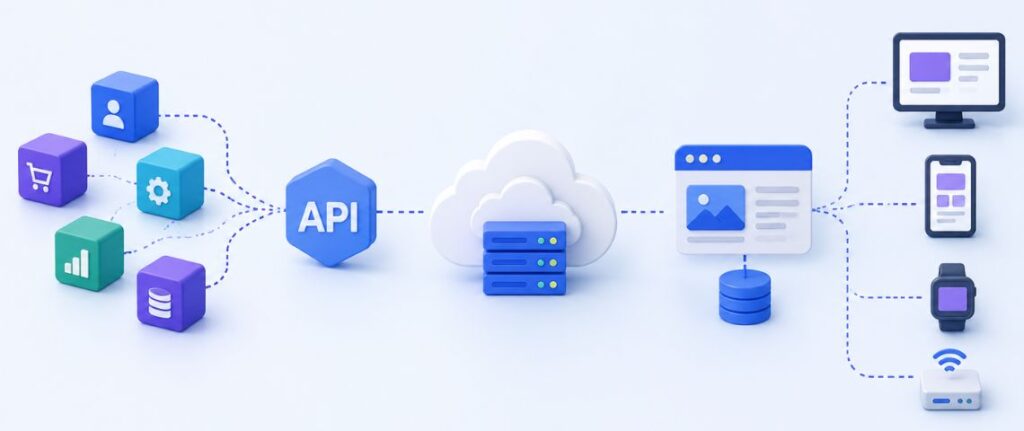
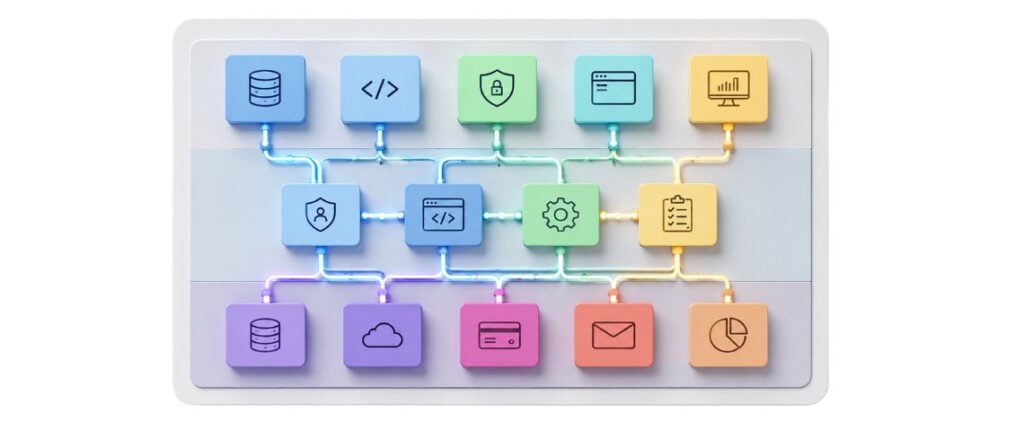
In the tech space, these “bricks” are often referred to as Packaged Business Capabilities (PBCs). A PBC is a well-defined, functional software component that represents a specific business feature—such as a shopping cart, a content management system (CMS), an identity verification service, or an analytics dashboard.
The MACH Principles
Modern composable ecosystems are rooted in the MACH acronym, a set of technical principles defined by the MACH Alliance:
- M – Microservices: Small, independently deployed services that focus on doing one specific business task exceptionally well.
- A – API-First: All functionalities are exposed through APIs, allowing different components to communicate seamlessly with one another.
- C – Cloud-Native SaaS: Applications are built natively for the cloud, leveraging elastic scaling, automatic updates, and resilient infrastructure.
- H – Headless: The backend logic and data storage are completely separated from the frontend user experience, allowing content to be delivered to web browsers, mobile apps, smartwatches, or IoT devices seamlessly.
By adhering to these principles, companies can escape the “vendor lock-in” typical of legacy suites and build agile platforms tailored perfectly to their unique workflows.
Why Modern Enterprises Demand a Scalable Software Architecture
As organizations expand, their software infrastructure must adapt to handle increased user traffic, larger datasets, and expanding operational complexities. Relying on rigid structures makes scaling an uphill battle. Investing in a scalable software architecture via composable design provides businesses with the structural elasticity they need to thrive.
1. Eliminating Single Points of Failure
In a monolith, a memory leak or a bug within a minor feature can bring down the entire system. In a composable setup, components are isolated. If your product recommendation engine experiences a sudden outage during a major sales event, your customers can still browse products, add items to their carts, and complete their purchases. The system degrades gracefully rather than crashing completely.
2. Independent Component Scaling
Different parts of an application experience different workloads. For example, an e-commerce site might see massive traffic spikes on its product search page during holiday shopping periods, while the user profile settings page remains largely untouched.
With a scalable software architecture, you can spin up additional cloud resources exclusively for the search microservice. This targeted scaling optimizes your cloud spend, ensures high performance, and prevents you from paying for unneeded computational power across your entire stack.
3. Accelerated Development and Time-to-Market
When software components are decoupled, development teams can work in parallel. One team can completely overhaul the blog layout using a headless CMS, while another integrates a new secure payment gateway. Because the components communicate via clean, unchanging API contracts, these teams don’t step on each other’s toes. Features move from ideation to production in days rather than months.
Key Benefits of Composable Architecture for Business Growth
Transitioning to a composable ecosystem is not just a technical upgrade; it is a strategic business decision. Let’s look at how this shift impacts your bottom line, operational efficiency, and customer satisfaction.
| Feature | Monolithic Architecture | Composable Architecture |
| Flexibility | Rigid; bound to a single vendor’s ecosystem. | Highly flexible; swap components as needed. |
| Time-to-Market | Slow changes require full system deployments. | Fast, independent deployments via APIs. |
| Scalability | Expensive; must scale the entire application. | Efficient; scale only the components under load. |
| Vendor Lock-in | High; shifting away is a multi-year project. | Low; easily replace individual service providers. |
Ultimate Omnichannel Agility
Modern consumers expect a unified experience across all touchpoints, whether they are shopping on a desktop website, using a mobile app, interacting with an in-store kiosk, or purchasing via a smart assistant.
Because composable setups utilize a headless frontend layer, your core business logic and content remain centralized. You can push product updates, marketing campaigns, and promotional pricing to every digital channel simultaneously through APIs. This guarantees a consistent brand experience without requiring your team to update multiple disconnected backends.
Absolute Freedom to Innovate
With traditional software suites, you are locked into the feature roadmap of a single vendor. If your enterprise system doesn’t natively support a new AI-driven personalization tool, you are out of luck—or stuck facing a massive custom integration invoice.
Composable design empowers your organization to adopt “best-of-breed” tools. If an innovative AI analytics platform hits the market today, your development team can integrate it into your existing API gateway within a few iterations, keeping your business at the cutting edge of your industry.
Maximizing ROI and Cost Efficiency
While building a composable stack requires thoughtful design up-front, it dramatically reduces long-term operational costs. You only pay for the exact services, APIs, and computing resources you use.
Furthermore, you can avoid costly, disruptive platform migrations down the road. Instead of undergoing a risky, expensive system overhaul every seven to ten years, you continuously evolve your platform by upgrading individual components incrementally.
Technical Pillars of a Composable System
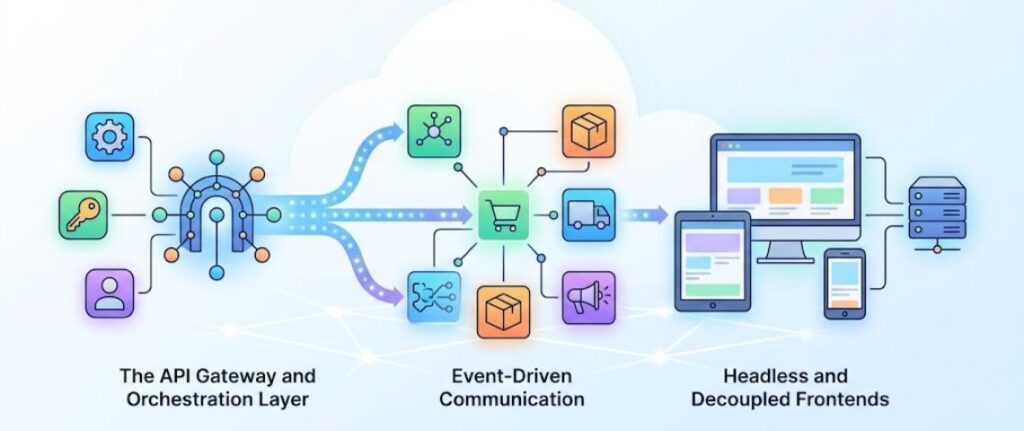
Building a robust composable platform requires a solid understanding of its underlying infrastructure components. A successful implementation relies heavily on three core technological pillars:
1. The API Gateway and Orchestration Layer
APIs are the nervous system of a composable architecture. When you have dozens of independent microservices handling data, you need a centralized post office to manage that traffic. An API Gateway acts as the single entry point for all client requests. It handles authentication, routes requests to the correct microservice, monitors performance, and ensures that data flows securely across your ecosystem.
Beyond simple routing, an orchestration or composition layer is often introduced. This layer takes data from multiple distinct services (e.g., customer details from a CRM, order history from an ERP, and content from a headless CMS) and aggregates it into a single, clean payload before delivering it to the frontend. This minimizes the number of network requests a user’s browser has to make, significantly improving load times and web vital scores.
2. Event-Driven Communication
In a sophisticated modular software architecture, components don’t just talk to each other directly; they react to events. An event-driven architecture uses message brokers (such as Apache Kafka or RabbitMQ) to broadcast when something happens within the system.
For instance, when a customer completes a purchase, the checkout service publishes an event titled Order_Completed. The inventory service listens for this event and automatically reduces stock counts. Simultaneously, the shipping service catches the event to print a warehouse label, and the notification engine triggers a confirmation email. This asynchronous design ensures that a slow response from the email server never delays the customer’s checkout process.
3. Headless and Decoupled Frontends
Separating the presentation layer (the frontend) from the database and business logic (the backend) is essential for modern user experiences. Developers can build high-performance frontends using modern JavaScript frameworks like React, Vue.js, or Next.js. These frameworks fetch data dynamically via fast API endpoints. This architecture allows companies to optimize web performance, fine-tune user journeys, and achieve exceptional desktop and mobile load speeds.
Overcoming Common Challenges in Composable Environments
While the benefits of a modular software architecture are undeniable, navigating its unique complexities requires careful planning and execution. Awareness of these common challenges enables you to engineer solutions proactively.
Managing System Complexity and Distributed Data
With multiple independent services running, data consistency can become a challenge. In a traditional setup, you can update multiple database tables simultaneously using a single SQL transaction. In a distributed, composable system, different services often utilize distinct databases.
To maintain consistency across services, engineers implement design patterns such as the Saga Pattern. A Saga manages distributed transactions by executing a series of local transactions across individual microservices. If one step fails, the Saga triggers compensating transactions to undo the previous steps, ensuring your system data remains accurate.
Ensuring Seamless Performance and Latency Control
Chaining too many synchronous API calls together can introduce network latency, resulting in a slow user experience. To avoid this bottleneck, maximize the use of asynchronous communication and implement robust caching mechanisms. Utilizing content delivery networks (CDNs) to cache API payloads close to your users, along with leveraging high-performance GraphQL or API gateways, keeps your interfaces lightning-fast and responsive.
Monitoring and Distributed Tracing
When an error occurs within a web of microservices, finding the root cause can feel like searching for a needle in a haystack. Traditional logging fails because logs are scattered across different server environments.
To overcome this, implement centralized logging and distributed tracing tools like OpenTelemetry, Datadog, or Jaeger. By attaching a unique trace ID to every incoming user request, your engineering team can follow the exact path of a transaction across multiple cloud services, making troubleshooting fast and intuitive.
The Role of Implevista in Digital Transformation
Navigating the complexities of modernizing your software infrastructure requires an experienced technology partner. At Implevista, we specialize in helping organizations transition from cumbersome monolithic software platforms into agile, scalable software architectures.
Our team of senior software architects, cloud engineers, and content strategists works alongside your business to map out a clear digital strategy. Whether you want to adopt a headless content ecosystem, design high-performing event-driven microservices, or orchestrate complex enterprise integrations, we have the practical expertise to deliver secure, resilient results.
Explore how we support your digital evolution across our core platforms:
- To learn more about our end-to-end software engineering capabilities, cloud infrastructure optimization, and agile enterprise development, visit our core hub at Implevista.
- Discover our deep-dive technology insights, architectural case studies, and engineering best practices by exploring the Implevista Blog.
- Accelerate your company’s digital transformation journeys and unlock modern enterprise automation strategies at Implevista Digital.
- Looking for innovative logistics, corporate mobility, or transit tracking solutions engineered on modular stacks? Check out our specialized platform at IVTrip.
No matter where you are in your architectural journey, we provide the technical blueprints and execution excellence to set your business up for sustained success.
Frequently Asked Questions (FAQ): Composable Architecture
1. What is composable architecture?
Composable architecture is an enterprise design approach where software applications are built using decoupled, independent, and interchangeable components (often called “packaged business capabilities”). These components connect via APIs, allowing businesses to swap out, update, or scale parts of their system without impacting the rest of the application.
2. What is the difference between composable and monolithic architecture?
A monolithic architecture binds all code, data access, and frontend components into a single, tightly coupled codebase, making updates complex and risky. Composable architecture breaks these functionalities down into independent, loosely coupled services that communicate via APIs, offering much greater flexibility, faster deployments, and efficient scaling.
3. How does modular software architecture benefit businesses?
A modular software architecture accelerates time-to-market, eliminates vendor lock-in, increases operational resilience, and reduces long-term maintenance costs. It allows distinct product teams to build, test, and deploy features in parallel without creating cross-team dependencies or causing system-wide downtime.
4. What are the key pillars of the MACH principles?
The MACH acronym stands for Microservices (independently deployed components), API-first (seamless integration via standardized endpoints), Cloud-Native SaaS (elastic cloud scaling and updates), and Headless (complete decoupling of frontend presentation from backend logic).
5. Why is a scalable software architecture important for enterprise growth?
A scalable software architecture ensures your digital applications handle traffic spikes, large data volumes, and growing user bases seamlessly. Composable design allows you to scale individual high-traffic modules independently, saving infrastructure costs while maintaining optimal application performance.
6. What is a headless CMS, and how does it fit into a composable stack?
A headless CMS is a content repository that manages content entirely on the backend without being tied to a specific frontend template. It exposes content via a REST or GraphQL API, allowing developers to display that content seamlessly across websites, mobile apps, smartwatches, and digital kiosks.
7. What is the Strangler Fig Pattern in software migration?
The Strangler Fig Pattern is a technique for transforming a monolithic application into a composable system incrementally. Instead of a high-risk system replacement, engineers gradually migrate individual business functionalities into cloud-native microservices until the legacy monolith can be safely decommissioned.
8. How do you maintain data consistency in a distributed modular system?
Data consistency across microservices is typically managed using event-driven design patterns, such as the Saga Pattern. Instead of relying on a single, centralized database transaction, a Saga coordinates a sequence of local transactions across services and executes compensating steps to revert changes if an error occurs.
9. What tools are used to monitor a composable architecture?
Because composable environments are highly distributed, organizations use centralized logging and distributed tracing tools like OpenTelemetry, Datadog, Dynatrace, or Jaeger. These tools track individual user requests as they traverse across different cloud services, making root-cause analysis straightforward.
10. How can Implevista help my company move to a composable setup?
Implevista provides comprehensive architectural consulting, cloud-native engineering, legacy modernization, and system integration services. We help businesses plan clear migration roadmaps, decouple legacy systems safely, and implement agile, API-first software ecosystems tailored to long-term business goals.
Conclusion: Ready to Build the Future of Your Business?
Adopting a modular software architecture empowers your organization to innovate freely, respond dynamically to market shifts, and scale efficiently. By focusing on decoupled, best-of-breed components linked via clean APIs, you create a robust, scalable software architecture built for long-term resilience.
As we kick off this Modern Software Architecture Series, remember that your tech stack should be an evolving asset, not a rigid constraint. You don’t have to navigate this digital transformation alone.
Take the Next Step with Implevista:
- Partner with Us: Ready to transform your legacy systems into a high-performance composable engine? Contact Implevista today to consult with our senior architects.
- Stay Informed: Keep pace with enterprise technology trends. Subscribe to the Implevista Blog for weekly architectural insights.
- Explore Our Solutions: Discover how we leverage cloud-native frameworks to accelerate organizational growth at Implevista Digital.